


- Retrait en 2 heures
- Assortiment impressionnant
- Paiement sécurisé
- Toujours un magasin près de chez vous
- Retrait en 2 heures
- Assortiment impressionnant
- Paiement sécurisé
- Toujours un magasin près de chez vous



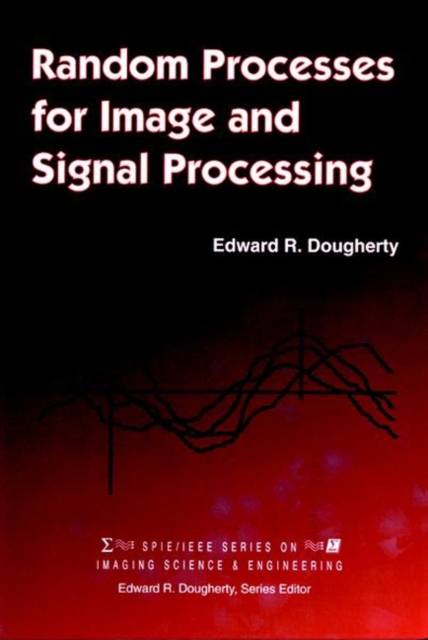
Random Processes for Image Signal Processing
Edward R Dougherty
176,97 €
Description
"This book gives readers an intuitive appreciation for random functions, plus theory and processes necessary for sophisticated applications. It covers probability theory, random processes, canonical representation, optimal filtering, and random models. Second in the SPIE/IEEE Series on Imaging Science & Engineering.
It also presents theory along with applications, to help readers intuitively appreciate random functions.
Included are special cases in which probabilistic insight is more readily achievable. When provided, proofs are in the main body of the text and clearly delineated; sometimes they are either not provided or outlines of conceptual arguments are given. The intent is to state theorems carefully and to draw clear distinctions between rigorous mathematical arguments and heuristic explanations. When a proof can be given at a mathematical level commensurate with the text and when it enhances conceptual understanding, it is usually provided; in other cases, the effort is to explain subtleties of the definitions and properties concerning random functions, and to state conditions under which a proposition applies. Attention is drawn to the differences between deterministic concepts and their random counterparts, for instance, in the mean-square calculus, orthonormal representation, and linear filtering. Such differences are sometimes glossed over in method books; however, lack of differentiation between random and deterministic analysis can lead to misinterpretation of experimental results and misuse of techniques.
The author's motivation for the book comes from his experience in teaching graduate-level image processing and having to end up teaching random processes. Even students who have taken a course on random processes have often done so in the context of linear operators on signals. This approach is inadequate for image processing. Nonlinear operators play a widening role in image processing, and the spatial nature of imaging makes it significantly different from one-dimensional signal processing. Moreover, students who have some background in stochastic processes often lack a unified view in terms of canonical representation and orthogonal projections in inner product spaces."
It also presents theory along with applications, to help readers intuitively appreciate random functions.
Included are special cases in which probabilistic insight is more readily achievable. When provided, proofs are in the main body of the text and clearly delineated; sometimes they are either not provided or outlines of conceptual arguments are given. The intent is to state theorems carefully and to draw clear distinctions between rigorous mathematical arguments and heuristic explanations. When a proof can be given at a mathematical level commensurate with the text and when it enhances conceptual understanding, it is usually provided; in other cases, the effort is to explain subtleties of the definitions and properties concerning random functions, and to state conditions under which a proposition applies. Attention is drawn to the differences between deterministic concepts and their random counterparts, for instance, in the mean-square calculus, orthonormal representation, and linear filtering. Such differences are sometimes glossed over in method books; however, lack of differentiation between random and deterministic analysis can lead to misinterpretation of experimental results and misuse of techniques.
The author's motivation for the book comes from his experience in teaching graduate-level image processing and having to end up teaching random processes. Even students who have taken a course on random processes have often done so in the context of linear operators on signals. This approach is inadequate for image processing. Nonlinear operators play a widening role in image processing, and the spatial nature of imaging makes it significantly different from one-dimensional signal processing. Moreover, students who have some background in stochastic processes often lack a unified view in terms of canonical representation and orthogonal projections in inner product spaces."
Spécifications
Parties prenantes
- Auteur(s) :
- Editeur:
Contenu
- Nombre de pages :
- 616
- Langue:
- Anglais
- Collection :
Caractéristiques
- EAN:
- 9780780334953
- Date de parution :
- 09-11-98
- Format:
- Livre relié
- Format numérique:
- Genaaid
- Dimensions :
- 184 mm x 259 mm
- Poids :
- 1301 g


Seulement chez Librairie Club
Cadeau


Les avis
Nous publions uniquement les avis qui respectent les conditions requises. Consultez nos conditions pour les avis.