


- Retrait en 2 heures
- Assortiment impressionnant
- Paiement sécurisé
- Toujours un magasin près de chez vous
- Retrait en 2 heures
- Assortiment impressionnant
- Paiement sécurisé
- Toujours un magasin près de chez vous



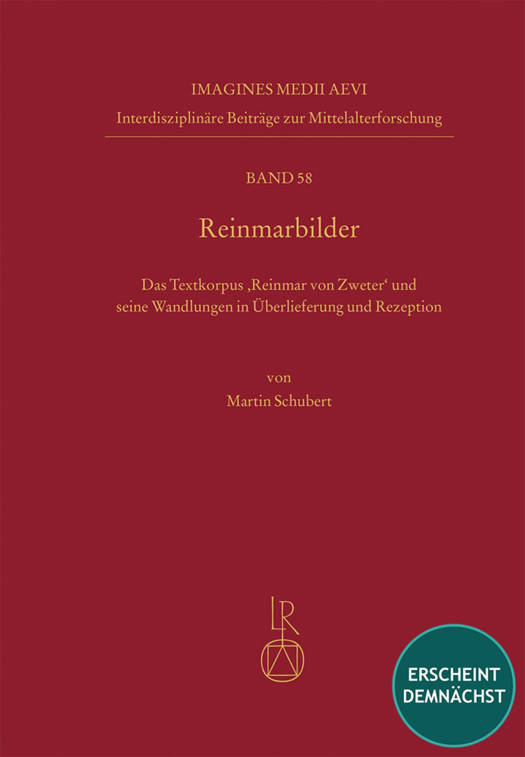
Reinmarbilder
Das Textkorpus 'Reinmar Von Zweter' Und Seine Wandlungen in Überlieferung Und Rezeption
Martin Schubert
144,45 €
+ 288 points
Description
Reinmar von Zweter is the most important Sangspruch poet between Walther von der Vogelweide and Frauenlob. The impressive corpus of poems attributed to him contains political, didactic, and spiritual stanzas as well as the religious 'Leich'. The reception of this corpus in the 13th century and long thereafter is quite extraordinary. Nevertheless, this oeuvre has not been the focus of a more detailed study since Gustav Roethe's comprehensive Reinmar edition (1887). For a long time, the oeuvre has been used for biographical interpretations only. Here, the aspect of the 'Reinmar images' emphasizes the various perspectives when looking at the poems. A detailed manuscript analysis shows how different images of 'Reinmar' were activated with each manuscript. The fact that the transmission can be traced back to an old Sangspruch collection, most likely from the author's lifetime, connects him in a special way with the manuscript culture of the 13th century. The Leich was intensively received, according to the number of manuscripts and the Latin contrafactum; the early fragments from the 13th century are unique within the genre. Reinmar images span from the written records and the picture in the Codex Manesse, over the fictional character 'Reinmar' in the 'Wartburg Contest' and references by other poets. For the notorious invective doenediep, it is argued that the ambiguity might be intentional. In the chain of images, Roethe's edition is considered another construct.
The literary study of the core corpus is divided in thematic cross sections. Special attention is paid to the catechetic aspects of the religious stanzas, the educational background, the role of the speaker, witticisms, and religious subtexts. In this case, the concept of the 'author' is not the aim of a biographical construct, but rather an index function of the texts which points to a moment in the history of literature. Thereby, new perspectives are opened on the innovations of an oeuvre that should not be considered epigonal again.
The literary study of the core corpus is divided in thematic cross sections. Special attention is paid to the catechetic aspects of the religious stanzas, the educational background, the role of the speaker, witticisms, and religious subtexts. In this case, the concept of the 'author' is not the aim of a biographical construct, but rather an index function of the texts which points to a moment in the history of literature. Thereby, new perspectives are opened on the innovations of an oeuvre that should not be considered epigonal again.
Spécifications
Parties prenantes
- Auteur(s) :
- Editeur:
Contenu
- Nombre de pages :
- 660
- Langue:
- Allemand
- Collection :
Caractéristiques
- EAN:
- 9783752007787
- Date de parution :
- 03-06-24
- Format:
- Livre relié
- Format numérique:
- Genaaid
- Dimensions :
- 180 mm x 43 mm
- Poids :
- 1233 g


Seulement chez Librairie Club
+ 288 points sur votre carte client de Librairie Club
Cadeau


Les avis
Nous publions uniquement les avis qui respectent les conditions requises. Consultez nos conditions pour les avis.