


- Retrait en 2 heures
- Assortiment impressionnant
- Paiement sécurisé
- Toujours un magasin près de chez vous
- Retrait en 2 heures
- Assortiment impressionnant
- Paiement sécurisé
- Toujours un magasin près de chez vous



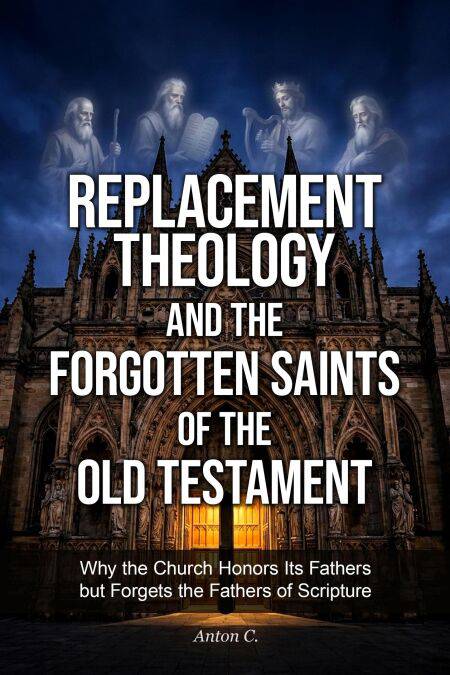
Replacement Theology and the Forgotten Saints of the Old Testament - Why the Church Honors Its Fathers but Forgets the Fathers of Scripture EBOOK
Replacement Theology, #3
Anton C.
2,99 €
+ 2 points
Description
Replacement Theology and the Forgotten Fathers asks a simple but powerful question: why has the Church forgotten the saints of the Old Testament? Abraham, Moses, David, and the prophets built the foundation of faith. Yet their names are missing from church calendars, feast days, and cathedrals.
Abraham, Moses, David, and the prophets stand at the very foundation of biblical faith. Yet in many Christian traditions, the title "saint" is commonly reserved for figures from the history of the Church rather than the great figures of the Hebrew Scriptures. This raises an important theological and historical question: how did this shift in Christian memory occur?
We call St. Anthony a saint, but not Saint Moses. Is Moses less than Anthony? Why this discrimination in honoring God's own servants?
Replacement Theology did more than replace a covenant. It erased the people who carried it. For centuries, the Western Church gave honor to apostles, bishops, and martyrs while ignoring the great figures of the Hebrew Scriptures.
The Forgotten Fathers exposes how this pattern shaped Christian memory, theology, and culture. It draws on Scripture, church history, liturgy, biblical theology, supersessionism, and Jewish‑Christian relations to show how the Old Testament saints were pushed aside.
These are only a few examples, and you can find many more in the Old Testament—men and women of faith who shaped God's story but were left without honor in the Western Church.
Without Abraham, there is no covenant. Without Moses, no law. Without David, no kingdom. Without the prophets, no promise of the Messiah. Without the Messiah, there is no church. Yet the Church that owes its faith to them has left their names off every door.
The Eastern Church kept their memory alive. Abraham has a feast day. Moses is celebrated in liturgy. Elijah is honored every July 20. These traditions prove that this forgetting was a human choice, not a divine command.
Forgotten Fathers is the first book to name this pattern directly, trace its causes thoroughly, and count its cost honestly. Drawing on Scripture, church history, liturgical records, canonization history, and hard dedication statistics from thousands of churches across the Western world, this book builds an argument that cannot be dismissed.
Replacement theology did not stop at declaring the old covenant fulfilled. It went further. It reduced the people of the Old Testament to theological shadows, stripped them of personal honor, excluded them from the canonization system by structural design, erased them from the liturgical calendar, and left their names off every door. While the church venerated St. Blaise, St. Giles, and hundreds of obscure medieval figures with feast days and dedications, Abraham and other saints remained without a cathedral.
The Forgotten Fathers invites readers to rediscover the faith's roots and restore honor to the saints who first believed. It is essential reading for anyone exploring Replacement Theology, church history, biblical studies, and Christian‑Jewish unity.
If God is not ashamed to be called their God, should the Church be ashamed to call them saints.
For readers of replacement theology, biblical theology, church history, Christian spirituality, and Jewish-Christian relations, this book is essential, overdue, and impossible to set aside.
Spécifications
Parties prenantes
- Auteur(s) :
- Editeur:
Contenu
- Langue:
- Anglais
- Collection :
Caractéristiques
- EAN:
- 9798233793516
- Date de parution :
- 09-04-26
- Format:
- Ebook
- Protection digitale:
- /
- Format numérique:
- ePub


Seulement chez Librairie Club
+ 2 points sur votre carte client de Librairie Club
Cadeau


Les avis
Nous publions uniquement les avis qui respectent les conditions requises. Consultez nos conditions pour les avis.