


Nous rencontrons actuellement des difficultés pour activer les ebooks. Par conséquent, la mise à disposition des ebooks que vous avez achetés pourrait prendre un peu plus de temps. Vous recevrez automatiquement un message dès que ce sera fait.
- Retrait en 2 heures
- Assortiment impressionnant
- Paiement sécurisé
- Toujours un magasin près de chez vous
Nous rencontrons actuellement des difficultés pour activer les ebooks. Par conséquent, la mise à disposition des ebooks que vous avez achetés pourrait prendre un peu plus de temps. Vous recevrez automatiquement un message dès que ce sera fait.
- Retrait en 2 heures
- Assortiment impressionnant
- Paiement sécurisé
- Toujours un magasin près de chez vous



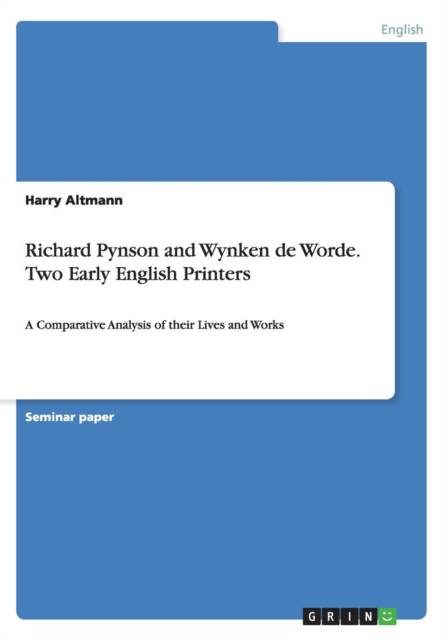
Richard Pynson and Wynken de Worde. Two Early English Printers
A Comparative Analysis of their Lives and Works
Harry Altmann
24,45 €
Description
Seminar paper from the year 2014 in the subject English Language and Literature Studies - Culture and Applied Geography, University of Münster (Buchwissenschaft), language: English, abstract: In today's world there are obvious qualitative and quantitative differences between the products of the print media, be they newspapers like "The Guardian" and "The Sun" or publishing houses such as "Faber & Faber" and "Bantam". "Quality paper" and "yellow press", "broad sheet" and "tabloid" are only some of the terms exemplifying this distinction.Looking at the situation in England at the end of the late fifteenth century and the beginning of the sixteenth century when printing was in its infancy, parallels to the contemporary situation can be identified. Five hundred years ago Richard Pynson and Wynkyn de Worde were amongst the first printers in England. Between them they produced well over a thousand individual titles. But their approaches to work as well as their positions in society were different, and so were their working methods and, thus, the different markets they supplied. The objective of this paper is to compare and to contrast the lives, works, and achievements of two influential printers of that time. The terminology used is the common terminology of book studies. Major research on this topic has been carried out for many years. Early publications such of those of E. Gordon Duff in the 1920s are still relevant. More recently, scholars such as Henry Robert Plomer, Pamela A. Neville and, Lotte Hellinga have contributed to this subject. All these authorities have been consulted in the preparation of this paper.
Spécifications
Parties prenantes
- Auteur(s) :
- Editeur:
Contenu
- Nombre de pages :
- 20
- Langue:
- Anglais
- Collection :
- Tome:
- n° 295094
Caractéristiques
- EAN:
- 9783656928058
- Date de parution :
- 25-03-15
- Format:
- Livre broché
- Dimensions :
- 148 mm x 210 mm
- Poids :
- 45 g



Seulement chez Librairie Club
+ 48 points sur votre carte client de Librairie Club
Cadeau


Les avis
Nous publions uniquement les avis qui respectent les conditions requises. Consultez nos conditions pour les avis.