


- Retrait en 2 heures
- Assortiment impressionnant
- Paiement sécurisé
- Toujours un magasin près de chez vous
- Retrait en 2 heures
- Assortiment impressionnant
- Paiement sécurisé
- Toujours un magasin près de chez vous



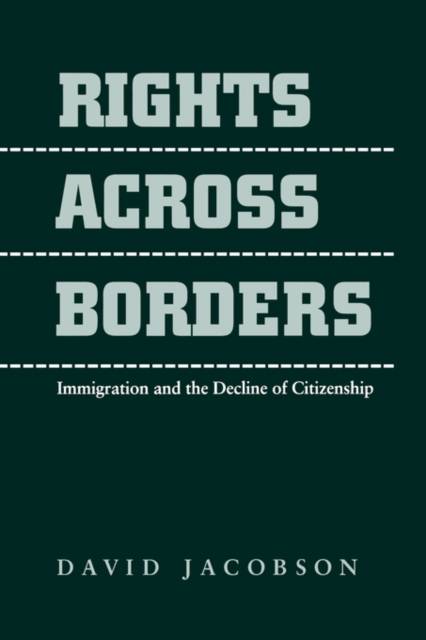
Rights Across Borders
Immigration and the Decline of Citizenship
David Jacobson
Livre broché | Anglais
46,95 €
+ 93 points
Description
In Rights across Borders, political sociologist David Jacobson argues that transnational migrations have affected ideas of citizenship and the state since World War II. Jacobson shows how citizenship has been increasingly devalued as governments extend rights to foreign populations and how, in turn, international human rights law has overshadowed traditional definitions of sovereignty. Examining illegal immigration in the United States and migrant and foreign populations in Western Europe, with a special focus on Germany and France, Jacobson shows how the differing political cultures of these countries-the ethnic basis of citizenship in Germany versus its political basis in the United States, for instance-have shaped both domestic and international politics. "This short but well-written book addresses a neglected aspect of the contemporary decline of the nation-state. It studies in depth the criteria by which France, Germany, and the United States distinguish between citizen and alien, from the political-territorial definition of the French to the ethno-cultural one of the Germans."-Francis Fukuyama, Foreign Affairs "Jacobson challenges scholars to rethink their views of the state. Current theories of political sociology and international relations are rooted in conceptions that, he feels, are losing their relevance and bite . . . A thought-provoking book."-Lawrence M. Friedman, Law and Politics Book Review "Few people discussing national and cultural identity or citizenship have looked at the legal ramifications of immigration. David Jacobson fills this gap in his important book."-Jeff Spinner-Halev, American Political Science Review "A compelling explanation of the intersection between transnational migration and human rights norms. It will be of interest to scholars of both international migration and human rights as well as a general reading audience interested in questions regarding immigration and citizenship"-Debra DeLaet, Perspectives on Political Science
Spécifications
Parties prenantes
- Auteur(s) :
- Editeur:
Contenu
- Nombre de pages :
- 200
- Langue:
- Anglais
Caractéristiques
- EAN:
- 9780801857706
- Date de parution :
- 01-09-97
- Format:
- Livre broché
- Format numérique:
- Trade paperback (VS)
- Dimensions :
- 154 mm x 229 mm
- Poids :
- 276 g


Seulement chez Librairie Club
+ 93 points sur votre carte client de Librairie Club
Cadeau


Les avis
Nous publions uniquement les avis qui respectent les conditions requises. Consultez nos conditions pour les avis.