


- Retrait en 2 heures
- Assortiment impressionnant
- Paiement sécurisé
- Toujours un magasin près de chez vous
- Retrait en 2 heures
- Assortiment impressionnant
- Paiement sécurisé
- Toujours un magasin près de chez vous



47,45 €
+ 94 points
Format
Description
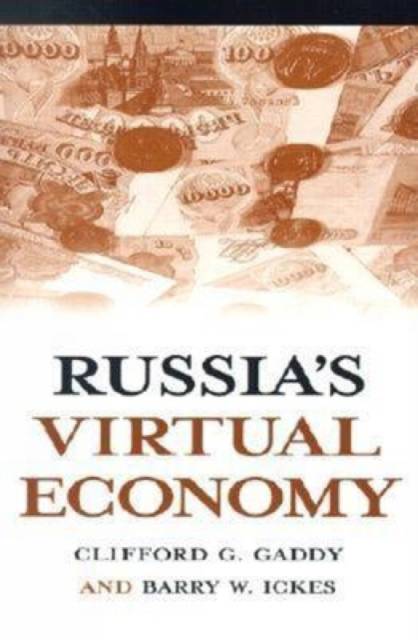
Clifford Gaddy's and Barry Ickes' paradigm of the ""virtual economy"" has fundamentally changed the way people think about Russia's economy. Circulated at the highest levels of the Russian and U.S. governments and reported in leading publications worldwide, their thesis--that Russia's economy is based on illusion or pretense about nearly every important economic yardstick, including prices, sales, wages and budgets--has forced broad recognition of the inadequacies of the intended market reform policies in Russia. More important, their work has provided a coherent framework for understanding how and why so much of Russia's economy has resisted reform. Gaddy and Ickes now use the virtual economy concept to project the near- and middle-term future of the Russian economy and suggest possible policy responses. Drawing on new empirical material from published and unpublished sources and from their own extensive field work in Russia, the authors examine critical aspects of the virtual economy: manufacturing enterprises, households and the public sectors, both local and federal. For the first time, they will also integrate the financial and agricultural sectors into their model. Gaddy's and Ickes' book can be expected to be a seminal work for understanding the inner workings of the Russian economy. Clifford G. Gaddy is a fellow in Foreign Policy Studies at the Brookings Institution and a member of Brookings' Center on Social and Economic Dynamics. He is the author of The Price of the Past: Russia's Struggle with the Legacy of a Militarized Economy (Brookings, 1996) and coauthor of Open for Business: Russia's Return to the Global Economy(Brookings, 1992). Barry W. Ickes is associate professor of economics at Pennsylvania State University and director of research at the New Economic School, Moscow.
Spécifications
Parties prenantes
- Auteur(s) :
- Editeur:
Contenu
- Nombre de pages :
- 322
- Langue:
- Anglais
Caractéristiques
- EAN:
- 9780815731115
- Date de parution :
- 01-07-02
- Format:
- Livre broché
- Format numérique:
- Trade paperback (VS)
- Dimensions :
- 153 mm x 233 mm
- Poids :
- 435 g



Seulement chez Librairie Club
+ 94 points sur votre carte client de Librairie Club
Cadeau


Les avis
Nous publions uniquement les avis qui respectent les conditions requises. Consultez nos conditions pour les avis.