


- Retrait en 2 heures
- Assortiment impressionnant
- Paiement sécurisé
- Toujours un magasin près de chez vous
- Retrait gratuit dans votre magasin Club
- 7.000.0000 titres dans notre catalogue
- Payer en toute sécurité
- Toujours un magasin près de chez vous



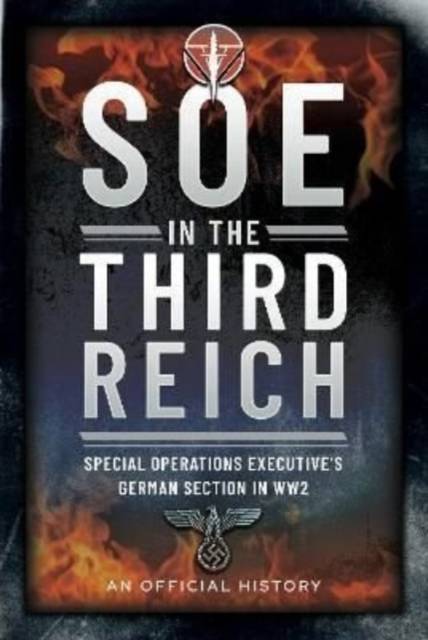
SOE in the Third Reich
Special Operations Executive's German Section in Ww2
An Official History
Livre relié | Anglais
34,95 €
+ 69 points
Description
'X' Section of S.O.2, a part of the Ministry of Economic Warfare, was formed in November 1940. Just two months later it came under the command of Major R.H. Thornley and, eventually, part of Special Operations Executive. Its role was to establish channels of communication into Germany and Austria for subversive activities and to build up inside those countries a network of agents.
From the very beginning, 'X' Section faced an enormous task penetrating Germany and Austria. Such were the difficulties faced, that it was the opinion of the Secret Intelligence Service that there was 'no point' in starting a German Section as it could never succeed.
The internal control exercised by the likes of the SS and Gestapo was so rigid that organized resistance in the accepted sense of the term was all but impossible inside Germany. Acknowledging, therefore, the handicaps with which he was faced, Thornley decided not to attempt the kind of large-scale operations conducted by SOE in Occupied territories. Instead, 'X' Section aimed at concentrating on sporadic sabotage wherever possible to alarm the enemy security services and engage in administrative sabotage, which was seen as a valuable weapon against the methodically minded Germans.
Its first two agents were sent into Germany via Yugoslavia in February 1941. In July of that year the first successful sabotage operation took place with the distribution of forged ration cards which disrupted the German economy; those caught spending the cards faced long prison sentences or even death.
Other such efforts followed, including using itching powder which was placed in clothing and bedding of German troops, the distribution of 'black' propaganda, and the spreading of alarm and despondency to weaken German morale. As the war progressed, 'X' Section expanded and the first operation of dropping an agent by parachute into Germany took place in February 1943. Information was also passed by radio from inside Germany and eventually, despite immense handicaps, a courier line was established between Austria/Germany and Switzerland.
Though limited in what it could hope to accomplish, 'X' Section achieved considerable success in 'soft' sabotage which unquestionably helped to undermine the Nazi war effort.
From the very beginning, 'X' Section faced an enormous task penetrating Germany and Austria. Such were the difficulties faced, that it was the opinion of the Secret Intelligence Service that there was 'no point' in starting a German Section as it could never succeed.
The internal control exercised by the likes of the SS and Gestapo was so rigid that organized resistance in the accepted sense of the term was all but impossible inside Germany. Acknowledging, therefore, the handicaps with which he was faced, Thornley decided not to attempt the kind of large-scale operations conducted by SOE in Occupied territories. Instead, 'X' Section aimed at concentrating on sporadic sabotage wherever possible to alarm the enemy security services and engage in administrative sabotage, which was seen as a valuable weapon against the methodically minded Germans.
Its first two agents were sent into Germany via Yugoslavia in February 1941. In July of that year the first successful sabotage operation took place with the distribution of forged ration cards which disrupted the German economy; those caught spending the cards faced long prison sentences or even death.
Other such efforts followed, including using itching powder which was placed in clothing and bedding of German troops, the distribution of 'black' propaganda, and the spreading of alarm and despondency to weaken German morale. As the war progressed, 'X' Section expanded and the first operation of dropping an agent by parachute into Germany took place in February 1943. Information was also passed by radio from inside Germany and eventually, despite immense handicaps, a courier line was established between Austria/Germany and Switzerland.
Though limited in what it could hope to accomplish, 'X' Section achieved considerable success in 'soft' sabotage which unquestionably helped to undermine the Nazi war effort.
Spécifications
Parties prenantes
- Auteur(s) :
- Editeur:
Contenu
- Nombre de pages :
- 224
- Langue:
- Anglais
Caractéristiques
- EAN:
- 9781399083348
- Date de parution :
- 31-12-26
- Format:
- Livre relié
- Format numérique:
- Genaaid
- Dimensions :
- 155 mm x 231 mm



Seulement chez Librairie Club
+ 69 points sur votre carte client de Librairie Club
Concours


Les avis
Nous publions uniquement les avis qui respectent les conditions requises. Consultez nos conditions pour les avis.