


- Retrait en 2 heures
- Assortiment impressionnant
- Paiement sécurisé
- Toujours un magasin près de chez vous
- Retrait gratuit dans votre magasin Club
- 7.000.0000 titres dans notre catalogue
- Payer en toute sécurité
- Toujours un magasin près de chez vous



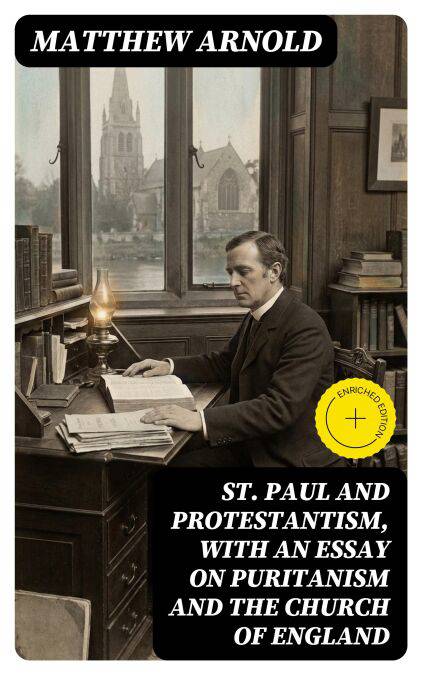
St. Paul and Protestantism, with an Essay on Puritanism and the Church of England EBOOK
Enriched edition.
Matthew Arnold
Ebook | Anglais
0,49 €
Format
Description
In "St. Paul and Protestantism, with an Essay on Puritanism and the Church of England," Matthew Arnold offers a profound examination of the interplay between religious thought and societal values during the 19th century. Through a critical lens, Arnold explores the theological implications of St. Paul's teachings, contrasting them with the tenets of Protestantism and Puritanism. His literary style is marked by eloquent prose and incisive analysis, expertly navigating complex theological concepts while drawing connections to contemporary issues of spirituality and morality. This work sits in the broader context of Arnold's objectives to reconcile faith with the advancing rationalism of his time, making it a pivotal text for understanding the cultural shifts of Victorian England. Matthew Arnold, a prominent Victorian poet and cultural critic, was deeply influenced by his background in education and his role as an inspector of schools. His exposure to various religious traditions and philosophies, along with his discontent with the dogmatism he perceived in contemporary religion, inspired him to critically assess the foundations of faith and its relevance to modern society. Arnold's own struggles with faith and reason permeate this work, reflecting his quest for a more harmonious relation between human experience and spiritual beliefs. This book is essential for readers interested in the intersections of faith, culture, and philosophy. Arnold's insightful critique not only challenges the reader to reconsider established doctrines but also invites contemplation on the role of religion in personal and communal identity amidst rapid societal change. "St. Paul and Protestantism" is a thought-provoking read for scholars and casual readers alike, resonating with those grappling with the relevance of faith in a modern world.
In this enriched edition, we have carefully created added value for your reading experience:
- A comprehensive Introduction outlines these selected works' unifying features, themes, or stylistic evolutions.
- The Author Biography highlights personal milestones and literary influences that shape the entire body of writing.
- A Historical Context section situates the works in their broader era—social currents, cultural trends, and key events that underpin their creation.
- A concise Synopsis (Selection) offers an accessible overview of the included texts, helping readers navigate plotlines and main ideas without revealing critical twists.
- A unified Analysis examines recurring motifs and stylistic hallmarks across the collection, tying the stories together while spotlighting the different work's strengths.
- Reflection questions inspire deeper contemplation of the author's overarching message, inviting readers to draw connections among different texts and relate them to modern contexts.
- Lastly, our hand‐picked Memorable Quotes distill pivotal lines and turning points, serving as touchstones for the collection's central themes.
In this enriched edition, we have carefully created added value for your reading experience:
- A comprehensive Introduction outlines these selected works' unifying features, themes, or stylistic evolutions.
- The Author Biography highlights personal milestones and literary influences that shape the entire body of writing.
- A Historical Context section situates the works in their broader era—social currents, cultural trends, and key events that underpin their creation.
- A concise Synopsis (Selection) offers an accessible overview of the included texts, helping readers navigate plotlines and main ideas without revealing critical twists.
- A unified Analysis examines recurring motifs and stylistic hallmarks across the collection, tying the stories together while spotlighting the different work's strengths.
- Reflection questions inspire deeper contemplation of the author's overarching message, inviting readers to draw connections among different texts and relate them to modern contexts.
- Lastly, our hand‐picked Memorable Quotes distill pivotal lines and turning points, serving as touchstones for the collection's central themes.
Spécifications
Parties prenantes
- Auteur(s) :
- Editeur:
Contenu
- Nombre de pages :
- 126
- Langue:
- Anglais
Caractéristiques
- EAN:
- 8596547312062
- Date de parution :
- 14-09-22
- Format:
- Ebook
- Protection digitale:
- Digital watermarking
- Format numérique:
- ePub



Seulement chez Librairie Club
Cadeau

Cadeau


Les avis
Nous publions uniquement les avis qui respectent les conditions requises. Consultez nos conditions pour les avis.