


- Retrait en 2 heures
- Assortiment impressionnant
- Paiement sécurisé
- Toujours un magasin près de chez vous
- Retrait en 2 heures
- Assortiment impressionnant
- Paiement sécurisé
- Toujours un magasin près de chez vous



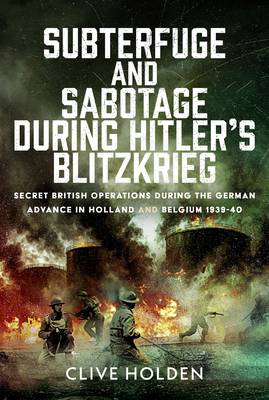
Subterfuge and Sabotage During Hitler's Blitzkrieg
Secret British Operations During the German Advance in Holland and Belgium, 1939-40
Clive Holden
Livre relié | Anglais
34,95 €
+ 69 points
Description
In September 1939 Britain was once again at war with Germany. In Whitehall, Prime Minister Chamberlain handed a senior cabinet minister the delicate task of co-ordinating plans for the denial to Germany of the vital economic assets of neutral Holland and Belgium should Hitler invade those countries.
Prominent among these important assets were those countries' oil stocks, which would have to be destroyed to prevent them falling into German hands. This task would eventually fall to a group of former cement workers who had been formed into a Territorial unit of the Royal Engineers. Little did they know then, that in just nine months some of them would find themselves across the North Sea conducting dangerous demolition operations in the face of the enemy.
Preparations for these operations, continued through the remaining months of 1939 into 1940 involving intelligence gathering, undercover reconnaissance missions, and weeks of intensive training for the naval and military demolition teams. Then, in May 1940, the German offensive in the West began and four Royal Navy destroyers set sail from Dover carrying demolition teams to their objectives in Dutch and Belgian ports. Upon arrival, they faced immediate challenges, including constant air attacks and the need for cooperation from reluctant local authorities. At the ports, the Royal Navy also found itself involved in operations to evacuate British civilians and officials, together with members of the Dutch Royal family, as well as salvaging stocks of gold bullion from bank vaults in a war-torn city. Amidst all this chaos the demolition teams carried out their tasks and then made their way back to England, displaying patience, tenacity, courage and sheer bloody-mindedness along the way.
The full story of the background, planning and execution of these little-known but dramatic operations and other events that surrounded them is told here in greater detail than ever before.
Prominent among these important assets were those countries' oil stocks, which would have to be destroyed to prevent them falling into German hands. This task would eventually fall to a group of former cement workers who had been formed into a Territorial unit of the Royal Engineers. Little did they know then, that in just nine months some of them would find themselves across the North Sea conducting dangerous demolition operations in the face of the enemy.
Preparations for these operations, continued through the remaining months of 1939 into 1940 involving intelligence gathering, undercover reconnaissance missions, and weeks of intensive training for the naval and military demolition teams. Then, in May 1940, the German offensive in the West began and four Royal Navy destroyers set sail from Dover carrying demolition teams to their objectives in Dutch and Belgian ports. Upon arrival, they faced immediate challenges, including constant air attacks and the need for cooperation from reluctant local authorities. At the ports, the Royal Navy also found itself involved in operations to evacuate British civilians and officials, together with members of the Dutch Royal family, as well as salvaging stocks of gold bullion from bank vaults in a war-torn city. Amidst all this chaos the demolition teams carried out their tasks and then made their way back to England, displaying patience, tenacity, courage and sheer bloody-mindedness along the way.
The full story of the background, planning and execution of these little-known but dramatic operations and other events that surrounded them is told here in greater detail than ever before.
Spécifications
Parties prenantes
- Auteur(s) :
- Editeur:
Contenu
- Nombre de pages :
- 320
- Langue:
- Anglais
Caractéristiques
- EAN:
- 9781036194567
- Date de parution :
- 30-11-26
- Format:
- Livre relié
- Format numérique:
- Genaaid
- Dimensions :
- 159 mm x 235 mm


Seulement chez Librairie Club
+ 69 points sur votre carte client de Librairie Club
Cadeau


Les avis
Nous publions uniquement les avis qui respectent les conditions requises. Consultez nos conditions pour les avis.