


- Retrait en 2 heures
- Assortiment impressionnant
- Paiement sécurisé
- Toujours un magasin près de chez vous
- Retrait en 2 heures
- Assortiment impressionnant
- Paiement sécurisé
- Toujours un magasin près de chez vous



79,95 €
+ 159 points
Description
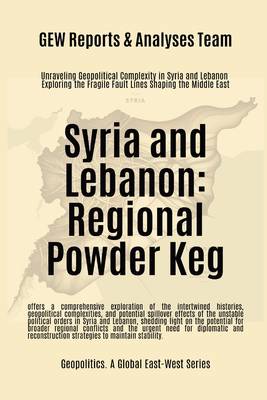
At the crossroads of war and diplomacy, Syria and Lebanon hold the keys to regional peace-or regional disaster.The interconnected histories of Syria and Lebanon have always formed a complex tapestry of alliances, conflicts, and shared cultural heritage. However, following recent political upheavals, both nations find themselves at the centre of a precarious and highly volatile regional landscape.This analysis delves into the intricate relationship between Syria and Lebanon, exploring how fragile political orders in both countries could spark broader regional conflicts affecting the entire Middle East. Syria's devastating civil war, beginning in 2011, has drawn numerous external actors-Russia, Iran, Turkey, the United States, Israel, and Gulf states-transforming the country into a dangerous arena for great power competition.Lebanon's precarious sectarian power-sharing system faces unprecedented challenges. The catastrophic 2020 Beirut port explosion, economic collapse, and governance failures have weakened state institutions, creating vacuums filled by non-state actors, most notably Hezbollah. This dual identity as both Lebanese political party and Iranian-aligned armed group creates particular regional complications.The Israel-Hezbollah dynamic represents perhaps the most dangerous potential trigger for wider conflict. Cross-border exchanges could rapidly escalate into full-scale warfare involving not just Lebanon and Israel, but potentially Iran and its regional proxies across multiple theatres.Additional spillover mechanisms include massive refugee movements, water security disputes, economic interconnections, and the potential for sectarian conflicts to ignite broader Sunni-Shia confrontations with Iran and Saudi Arabia as primary patrons.Understanding these dynamics requires recognising that Syria and Lebanon function less as traditional nation-states and more as complex battlegrounds where local, regional, and international interests collide. The essay concludes with three future scenarios, examining possible resolutions through international diplomacy and reconstruction strategies whilst addressing constraints preventing progress. Any comprehensive approach to regional stability must tackle immediate security concerns alongside underlying governance failures, economic challenges, and sectarian tensions fuelling conflict.
Spécifications
Parties prenantes
- Auteur(s) :
- Editeur:
Contenu
- Nombre de pages :
- 340
- Langue:
- Anglais
Caractéristiques
- EAN:
- 9781787954465
- Date de parution :
- 20-08-25
- Format:
- Livre broché
- Format numérique:
- Trade paperback (VS)
- Dimensions :
- 152 mm x 229 mm
- Poids :
- 453 g


Seulement chez Librairie Club
+ 159 points sur votre carte client de Librairie Club
Cadeau


Les avis
Nous publions uniquement les avis qui respectent les conditions requises. Consultez nos conditions pour les avis.