


- Retrait en 2 heures
- Assortiment impressionnant
- Paiement sécurisé
- Toujours un magasin près de chez vous
- Retrait en 2 heures
- Assortiment impressionnant
- Paiement sécurisé
- Toujours un magasin près de chez vous



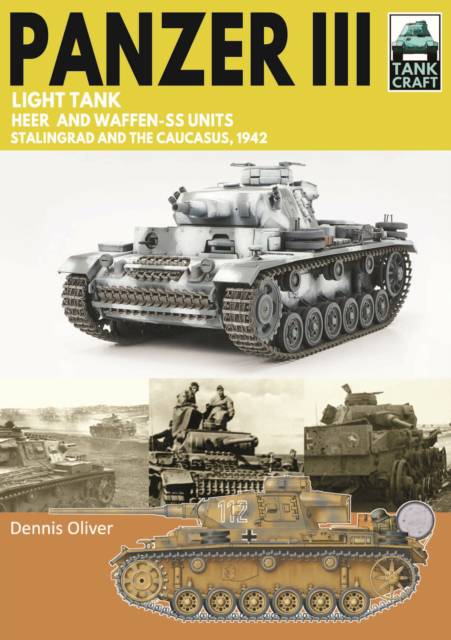
Tank Craft 50 Panzer III Light Tank
Stalingrad and the Caucasus, 1942
Dennis Oliver
Livre broché | Anglais
27,95 €
+ 55 points
Description
By the spring of 1942 the Panzerkampfwagen III, or Pz.Kpfw. III, which was commonly known as the Panzer III, which had first seen service in the Polish Campaign, was still the most numerically important armoured fighting vehicle in the Wehrmacht's arsenal.
Spearheading the Panzer divisions during the Blitzkrieg era, the Pz.Kpfw. III was less heavily armoured than many of its opponents, but it was sturdy and reliable, while its main armament was the equal of any enemy weapon it was called upon to face. The basic version was continuously up-gunned and up-armoured, while maintaining its speed and manoeuvrability, and the later variants could still be considered a potent, modern weapons system.
Operating on the open plains of modern-day Belarus and Ukraine, the Pzkpfw III was at the forefront of the dramatic advances of 1941 and would be called upon to bear the burden of the effort in the offensives planned for the following year which, if all went to plan, would knock the Soviet Union out of the war.
This volume of the TankCraft series continues the story of the tank's wartime service, examining the models that took part in the fighting on the Eastern Front beginning with the spectacular advance to the doorstep of Asia and into the Caucasus region in June 1942 and ending with the savage battles in the streets of Stalingrad. Dennis Oliver uses archive photos and extensively researched colour illustrations to examine the Pzkpfw III and the Panzer units that took part in these crucial struggles.
A key section of his book displays available model kits and aftermarket products, complemented by a gallery of beautifully constructed and painted models in various scales. Technical details as well as modifications introduced during production and in the field are also examined, providing everything the modeller needs to recreate an accurate representation of these historic tanks.
Spearheading the Panzer divisions during the Blitzkrieg era, the Pz.Kpfw. III was less heavily armoured than many of its opponents, but it was sturdy and reliable, while its main armament was the equal of any enemy weapon it was called upon to face. The basic version was continuously up-gunned and up-armoured, while maintaining its speed and manoeuvrability, and the later variants could still be considered a potent, modern weapons system.
Operating on the open plains of modern-day Belarus and Ukraine, the Pzkpfw III was at the forefront of the dramatic advances of 1941 and would be called upon to bear the burden of the effort in the offensives planned for the following year which, if all went to plan, would knock the Soviet Union out of the war.
This volume of the TankCraft series continues the story of the tank's wartime service, examining the models that took part in the fighting on the Eastern Front beginning with the spectacular advance to the doorstep of Asia and into the Caucasus region in June 1942 and ending with the savage battles in the streets of Stalingrad. Dennis Oliver uses archive photos and extensively researched colour illustrations to examine the Pzkpfw III and the Panzer units that took part in these crucial struggles.
A key section of his book displays available model kits and aftermarket products, complemented by a gallery of beautifully constructed and painted models in various scales. Technical details as well as modifications introduced during production and in the field are also examined, providing everything the modeller needs to recreate an accurate representation of these historic tanks.
Spécifications
Parties prenantes
- Auteur(s) :
- Editeur:
Contenu
- Nombre de pages :
- 64
- Langue:
- Anglais
Caractéristiques
- EAN:
- 9781036185220
- Date de parution :
- 30-11-26
- Format:
- Livre broché
- Format numérique:
- Trade paperback (VS)
- Dimensions :
- 210 mm x 298 mm


Seulement chez Librairie Club
+ 55 points sur votre carte client de Librairie Club
Cadeau


Les avis
Nous publions uniquement les avis qui respectent les conditions requises. Consultez nos conditions pour les avis.