


- Retrait en 2 heures
- Assortiment impressionnant
- Paiement sécurisé
- Toujours un magasin près de chez vous
- Retrait en 2 heures
- Assortiment impressionnant
- Paiement sécurisé
- Toujours un magasin près de chez vous



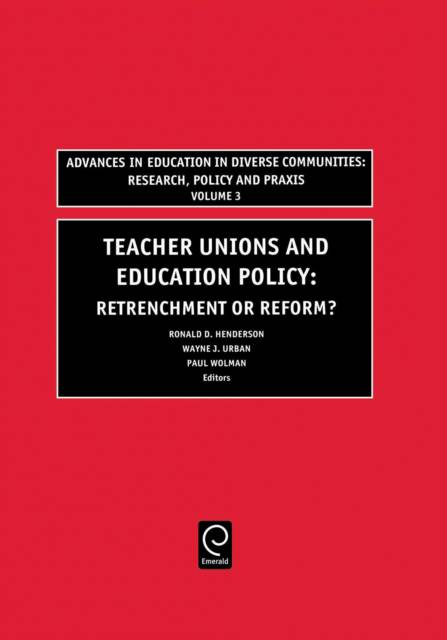
Teachers Unions and Education Policy
Retrenchment or Reform?
269,45 €
+ 538 points
Description
The American public has increasingly heard that teacher unions and quality education are contradictory terms and that unions are responsible for the failure of public schools. Many critics of the unions would cheerfully channel public funds to largely nonunion private and parochial schools as free market alternatives. The present volume, edited by friends of the teacher unions and featuring contributions by prominent education scholars as well as union activists, has a far more positive perspective on the achievements and value of teacher unions and our public education system. The collection does not avoid critical examination of the teacher unions, however. Moreover, taken as a whole, it speaks to the need for continuing reform and renovation within the unions themselves, and it affirms a need for innovation and competition within public education as a way of enhancing its quality. Toward those ends, the volume first reviews the substantial contributions that teachers and their unions have made to the well being of their members and the education of students over more than a hundred years. It then explores collective bargaining as it affects reform and educational quality. It continues by examining the real-world outcomes of education in unionized environments; taking an inside look at a turn toward bipartisanship in the NEAs political and lobbying activities; and analyzing the unions recent record in shaping education legislation and policy. The book also examines teacher union activities in higher education; the innovative work of local reform unions; union support for education research and development; and the shape of a teacher unionism specifically organized to promote educational quality. The volume concludes by tracing the development and current activities of international education associations as defendersin both the developed and developing countriesof the teaching profession and of the rights of all children to a quality education. This book is no mere reverie on a heroic union past. It is instead an exploration of past and present as prologues to the manifold possibilities for enhancing the unions contributions to quality public education.
Spécifications
Parties prenantes
- Editeur:
Contenu
- Nombre de pages :
- 302
- Langue:
- Anglais
- Collection :
- Tome:
- n° 3
Caractéristiques
- EAN:
- 9780762308286
- Date de parution :
- 30-09-04
- Format:
- Livre relié
- Format numérique:
- Genaaid
- Dimensions :
- 164 mm x 229 mm
- Poids :
- 566 g

Seulement chez Librairie Club
+ 538 points sur votre carte client de Librairie Club
Cadeau

Cadeau


Les avis
Nous publions uniquement les avis qui respectent les conditions requises. Consultez nos conditions pour les avis.