


- Retrait en 2 heures
- Assortiment impressionnant
- Paiement sécurisé
- Toujours un magasin près de chez vous
- Retrait en 2 heures
- Assortiment impressionnant
- Paiement sécurisé
- Toujours un magasin près de chez vous



63,35 €
+ 126 points
Description
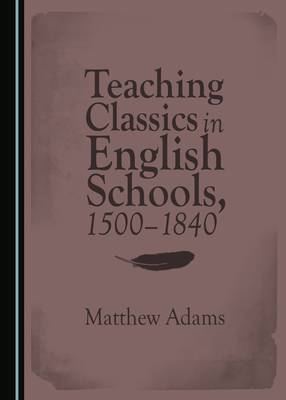
From the sixteenth century, schools across the country competed to establish curricula rich with classical authority, so that a school founded in Somerset or in Yorkshire, say, would expect to teach a timetable very similar to that of a school founded in London. In the years that followed, the teaching of the Latin and Greek languages was developed and re-moulded in order to withstand opposition in a changing social and cultural climate. For many, the whip and the lash became synonymous with Latin and Greek, and increasing public frustration meant that teachers of Classics had to adapt in order to survive: by the end of the period, the languages appeared stronger than ever, in a leaner, fitter form, aided by the work of some exceptional, brilliant teachers. By the middle of the nineteenth century, Classics had successfully secured its position in the classroom and remained an essential element of the school curriculum. This book provides a concise and engaging history of classical education in English schools, beginning in 1500 with massive educational developments in England as humanist studies reached this country from abroad; it ends with the headmastership of Thomas Arnold of Rugby School, who died in 1842, and whose influence on schools helped secure Latin and Greek as the staple of an English education. By examining the pedagogical origins of Latin and Greek in the school curriculum, the book provides historical perspective to the modern study of Classics, revealing how and why the school curriculum developed as it did. The book also shows how schools responded and adapted to societal needs, and charts social change through the prism of classical education in English schools over a period of 350 years. Teaching Classics in English Schools, 1500-1840 provides an overview and insight into the world of classical education from the Renaissance to the Victorians without becoming entrenched in the analytical in-depth interpretative questions which can often detract from a book's readability. The survey of classical education within the pages of this book will prove useful for anyone wishing to place the teaching of Classics in its cultural and educational context. It includes previously unpublished material, and a new synthesis and analysis of the teaching of Classics in English schools. This will be the perfect reference book for those who teach classical subjects, in both schools and universities, and also for university students who are studying Classical Reception as part of their taught or research degree. It will also be of interest to many schools of older foundation mentioned in this book and to anyone with leanings towards the history of education or English social history.
Spécifications
Parties prenantes
- Auteur(s) :
- Editeur:
Contenu
- Nombre de pages :
- 210
- Langue:
- Anglais
Caractéristiques
- EAN:
- 9781443881142
- Date de parution :
- 16-12-15
- Format:
- Livre relié
- Format numérique:
- Genaaid
- Dimensions :
- 147 mm x 208 mm
- Poids :
- 421 g


Seulement chez Librairie Club
+ 126 points sur votre carte client de Librairie Club
Cadeau


Les avis
Nous publions uniquement les avis qui respectent les conditions requises. Consultez nos conditions pour les avis.