


- Retrait en 2 heures
- Assortiment impressionnant
- Paiement sécurisé
- Toujours un magasin près de chez vous
- Retrait gratuit dans votre magasin Club
- 7.000.0000 titres dans notre catalogue
- Payer en toute sécurité
- Toujours un magasin près de chez vous



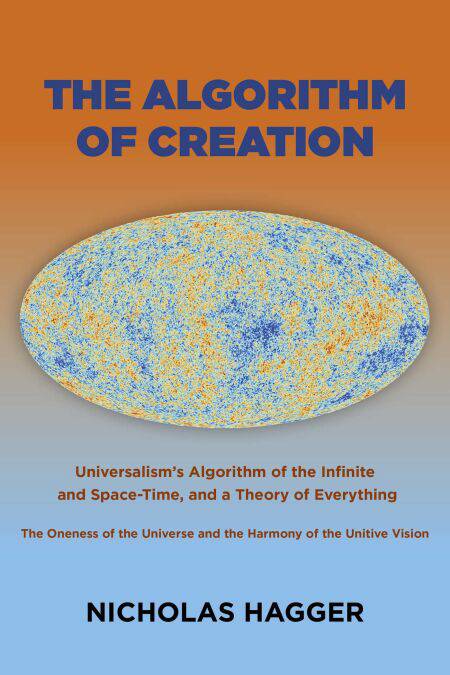
The Algorithm of Creation EBOOK
Universalism's Algorithm of the Infinite and Space-Time, the Oneness of the Universe and the Unitive Vision, and a Theory of Everything
Nicholas Hagger
Ebook | Anglais
17,88 €
+ 17 points
Description
2023 SMN Book Prize Winner - Significant Contribution to its Field
The Algorithm of Creation is the last of Nicholas Hagger’s quartet on the unity of the universe and humankind, and follows The Universe and the Light (1993), The One and the Many (1999) and The New Philosophy of Universalism (2009). It offers an algebraic formula written out for him by Junzaburo Nishiwaki, Japan’s T.S. Eliot, in Tokyo in October 1965, that sums up the wisdom of the East: “+A + –A = 0.” Based on ancient Chinese thinking, yin (dark) + yang (light) = the Tao, it shows all opposites reconciled in the underlying unity of the One Void whose emptiness is also a fullness.
During a dinner at a conference of leading scientists at Jesus College, Cambridge in September 1992, watched by Nobel physics prizewinner Roger Penrose, Hagger reversed the formula to 0 = +A + –A when he wrote down the maths for his view of the origin and creation of the universe and showed the first two particles emerging from the Void’s singularity, influenced by the 1992 discovery of ripples in the cosmic microwave background radiation and the Presocratic Anaximander of Miletus.
In this work Hagger shows how this algebraic formula has worked as a universal algorithm, 0 = +A + –A = 0. Its many variations have acted as rules that have controlled the creation and development of the expanding universe, its evolution and the rise of human history, religion and science, and its ultimate fate. The formula is behind many of Hagger’s works, and his application of this algorithm to all human knowledge of the universe and all disciplines takes him to a first-ever Theory of Everything, which is set out at the end: the algorithm of Creation containing 100 mathematical symbols (reflecting all the variations) that can be summed up in the above algorithm. This startling achievement has been made possible by his Universalist cross-disciplinary approach which focuses on the fundamental oneness of the universe and humankind, and the unitive vision.
The Algorithm of Creation is the last of Nicholas Hagger’s quartet on the unity of the universe and humankind, and follows The Universe and the Light (1993), The One and the Many (1999) and The New Philosophy of Universalism (2009). It offers an algebraic formula written out for him by Junzaburo Nishiwaki, Japan’s T.S. Eliot, in Tokyo in October 1965, that sums up the wisdom of the East: “+A + –A = 0.” Based on ancient Chinese thinking, yin (dark) + yang (light) = the Tao, it shows all opposites reconciled in the underlying unity of the One Void whose emptiness is also a fullness.
During a dinner at a conference of leading scientists at Jesus College, Cambridge in September 1992, watched by Nobel physics prizewinner Roger Penrose, Hagger reversed the formula to 0 = +A + –A when he wrote down the maths for his view of the origin and creation of the universe and showed the first two particles emerging from the Void’s singularity, influenced by the 1992 discovery of ripples in the cosmic microwave background radiation and the Presocratic Anaximander of Miletus.
In this work Hagger shows how this algebraic formula has worked as a universal algorithm, 0 = +A + –A = 0. Its many variations have acted as rules that have controlled the creation and development of the expanding universe, its evolution and the rise of human history, religion and science, and its ultimate fate. The formula is behind many of Hagger’s works, and his application of this algorithm to all human knowledge of the universe and all disciplines takes him to a first-ever Theory of Everything, which is set out at the end: the algorithm of Creation containing 100 mathematical symbols (reflecting all the variations) that can be summed up in the above algorithm. This startling achievement has been made possible by his Universalist cross-disciplinary approach which focuses on the fundamental oneness of the universe and humankind, and the unitive vision.
Spécifications
Parties prenantes
- Auteur(s) :
- Editeur:
Contenu
- Nombre de pages :
- 448
- Langue:
- Anglais
Caractéristiques
- EAN:
- 9781785351389
- Date de parution :
- 26-10-23
- Format:
- Ebook
- Protection digitale:
- Adobe DRM
- Format numérique:
- ePub


Seulement chez Librairie Club
+ 17 points sur votre carte client de Librairie Club
Cadeau

Cadeau


Les avis
Nous publions uniquement les avis qui respectent les conditions requises. Consultez nos conditions pour les avis.