


- Retrait en 2 heures
- Assortiment impressionnant
- Paiement sécurisé
- Toujours un magasin près de chez vous
- Retrait en 2 heures
- Assortiment impressionnant
- Paiement sécurisé
- Toujours un magasin près de chez vous



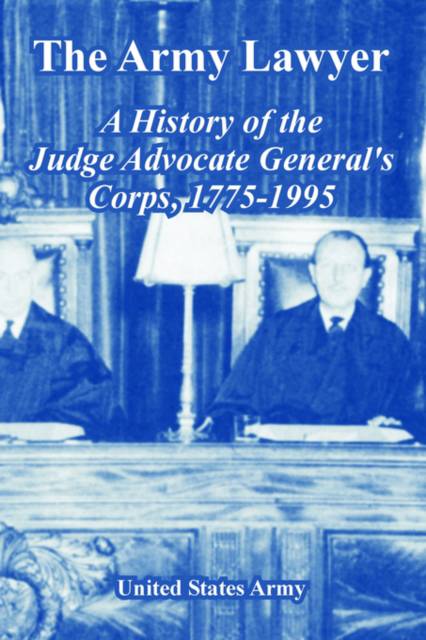
The Army Lawyer
A History of the Judge Advocate General's Corps, 1775-1995
United States Army
Livre broché | Anglais
40,45 €
+ 80 points
Description
War has been said to be an impersonal thing, and in many respects it is. However, armies are necessarily composed of human beings-who perform or influence the performance of great actions; who bring new growth and new challenge; and who have the capacity to leave a legacy of honor, hard work and respect for the law. This is a history of such people. It is also a history of the law they practiced, where their deeds and dreams depend for explanation upon the conditions and circumstances of their time. Many kinds of lawyers appear here in text and vignette. Wells Blodgett, Blanton Winship and Eugene Caffey were combat soldiers of great distinction, wearers of the Medal of Honor, Distinguished Service Cross or Silver Star. Important, too, were the citizen-soldiers, members of the Reserve and National Guard, who left home and work to answer wartime needs. There are "great" names, too: John Marshall and Felix Frankfurter of the Supreme Court; great law teachers such as John Chipman Gray, Edmund Morgan, and John Henry Wigmore; and such prominent public servants as Henry L. Stimson, Enoch Crowder, Patrick J. Hurley, and Leon Jaworski. The unique American military legal system both produced and is the product of great lawyers. After John Adams, who introduced the first major criminal code in the Continental Congress in 1776, the efforts of men like William Winthrop, Samuel Ansell and Kenneth Hodson produced proud chapters in the history of the law. Finally, there is a general category of men who participated in key events in our history, who responded to the various challenges and tests. Judge Advocates from the beginning to modern days had the burden of conducting trials in the glare of publicity: the prosecutions of Benedict Arnold, the assassins of President Lincoln, and the Nazi saboteurs come to mind. Other "events" presented opportunities for bold, forthright public service by the Judge Advocates General of the time: the Army's growth from 200,000 to eight million men in World War II; implementation of a revolutionary Uniform Code of Military Justice during combat in Korea; and the most recent problems of a new kind of war and new forms of public reaction. Judge Advocates General George Davis, Myron Cramer, Ernest Brannon and Charles Decker, among others, were the architects of adjustment to the demands of modern war and politics as "the world's largest law firm" finished the last decades of its second century.
Spécifications
Parties prenantes
- Auteur(s) :
- Editeur:
Contenu
- Nombre de pages :
- 288
- Langue:
- Anglais
Caractéristiques
- EAN:
- 9781410222787
- Date de parution :
- 21-05-05
- Format:
- Livre broché
- Format numérique:
- Trade paperback (VS)
- Dimensions :
- 152 mm x 229 mm
- Poids :
- 426 g


Seulement chez Librairie Club
+ 80 points sur votre carte client de Librairie Club
Cadeau


Les avis
Nous publions uniquement les avis qui respectent les conditions requises. Consultez nos conditions pour les avis.