


- Retrait en 2 heures
- Assortiment impressionnant
- Paiement sécurisé
- Toujours un magasin près de chez vous
- Retrait en 2 heures
- Assortiment impressionnant
- Paiement sécurisé
- Toujours un magasin près de chez vous



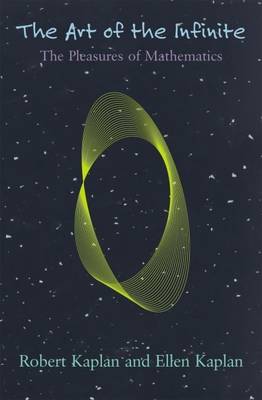
The Art of the Infinite
The Pleasures of Mathematics
Robert Kaplan, Ellen Kaplan
Livre relié | Anglais
38,95 €
+ 77 points
Description
Robert Kaplan's The Nothing That Is: A Natural History of Zero was an international best-seller, translated into eight languages. The Times called it "elegant, discursive, and littered with quotes and allusions from Aquinas via Gershwin to Woolf" and The Philadelphia Inquirer praised it as "absolutely scintillating."
In this delightful new book, Robert Kaplan, writing together with his wife Ellen Kaplan, once again takes us on a witty, literate, and accessible tour of the world of mathematics. Where The Nothing That Is looked at math through the lens of zero, The Art of the Infinite takes infinity, in its countless guises, as a touchstone for understanding mathematical thinking. Tracing a path from Pythagoras, whose great Theorem led inexorably to a discovery that his followers tried in vain to keep secret (the existence of irrational numbers); through Descartes and Leibniz; to the brilliant, haunted Georg Cantor, who proved that infinity can come in different sizes, the Kaplans show how the attempt to grasp the ungraspable embodies the essence of mathematics. The Kaplans guide us through the "Republic of Numbers," where we meet both its upstanding citizens and more shadowy dwellers; and we travel across the plane of geometry into the unlikely realm where parallel lines meet. Along the way, deft character studies of great mathematicians (and equally colorful lesser ones) illustrate the opposed yet intertwined modes of mathematical thinking: the intutionist notion that we discover mathematical truth as it exists, and the formalist belief that math is true because we invent consistent rules for it.
"Less than All," wrote William Blake, "cannot satisfy Man." The Art of the Infinite shows us some of the ways that Man has grappled with All, and reveals mathematics as one of the most exhilarating expressions of the human imagination.
In this delightful new book, Robert Kaplan, writing together with his wife Ellen Kaplan, once again takes us on a witty, literate, and accessible tour of the world of mathematics. Where The Nothing That Is looked at math through the lens of zero, The Art of the Infinite takes infinity, in its countless guises, as a touchstone for understanding mathematical thinking. Tracing a path from Pythagoras, whose great Theorem led inexorably to a discovery that his followers tried in vain to keep secret (the existence of irrational numbers); through Descartes and Leibniz; to the brilliant, haunted Georg Cantor, who proved that infinity can come in different sizes, the Kaplans show how the attempt to grasp the ungraspable embodies the essence of mathematics. The Kaplans guide us through the "Republic of Numbers," where we meet both its upstanding citizens and more shadowy dwellers; and we travel across the plane of geometry into the unlikely realm where parallel lines meet. Along the way, deft character studies of great mathematicians (and equally colorful lesser ones) illustrate the opposed yet intertwined modes of mathematical thinking: the intutionist notion that we discover mathematical truth as it exists, and the formalist belief that math is true because we invent consistent rules for it.
"Less than All," wrote William Blake, "cannot satisfy Man." The Art of the Infinite shows us some of the ways that Man has grappled with All, and reveals mathematics as one of the most exhilarating expressions of the human imagination.
Spécifications
Parties prenantes
- Auteur(s) :
- Editeur:
Contenu
- Nombre de pages :
- 336
- Langue:
- Anglais
Caractéristiques
- EAN:
- 9780195147438
- Date de parution :
- 03-04-03
- Format:
- Livre relié
- Format numérique:
- Genaaid
- Dimensions :
- 161 mm x 244 mm
- Poids :
- 639 g


Seulement chez Librairie Club
+ 77 points sur votre carte client de Librairie Club
Cadeau


Les avis
Nous publions uniquement les avis qui respectent les conditions requises. Consultez nos conditions pour les avis.