


- Retrait en 2 heures
- Assortiment impressionnant
- Paiement sécurisé
- Toujours un magasin près de chez vous
- Retrait gratuit dans votre magasin Club
- 7.000.0000 titres dans notre catalogue
- Payer en toute sécurité
- Toujours un magasin près de chez vous



119,82 €
+ 239 points
Description
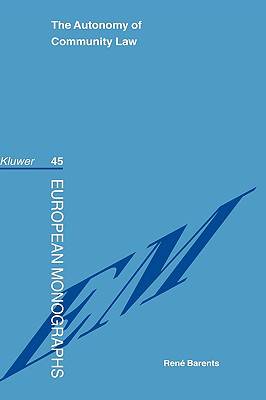
Does European Community law represent a new kind of transnational constitutional law? The question is important in the long term because it relates to the future of Europe. More immediately, it concerns the manner in which Community law is interpreted by courts. According to the case law of several national courts, Community law is a special form of international law, ultimately controlled by the Member States. According to the case law of the European Court of Justice, however, it is a form of constitutional law which cannot be controlled by national courts. In the European Court¿s case law the special nature of Community is described in terms of ¿autonomy¿. In this ground-breaking book, a major scholar of European law rigorously demonstrates that this concept arises organically from the origin, system and content of the European treaties; it is in fact an interpretation of Community law according to its own system, independent of national law. On this basis the book clearly explains what the special nature of Community law amounts to and the theoretical and practical consequences that follow from this interpretation. Professor Barents shows why Community law can be seen as a clear example of a new phenomenon: the emergence of non-national or global law, reflecting the reality that in the process of globalisation the nation-state begins to lose its control over the law applicable in its territory. In this stimulating context, many of the difficult issues that often arise in discussions of Community law are treated in depth, including the following: the relationship between national law and international law in general and the relationship between Community law and national law in particular (primacy, direct effect);the process of constitutionalisation of Community law;the ¿battle¿ between national constitutional courts and the European Court of Justice;the significance of Community law for the law of the European Union;the ¿penetration¿ of Community law into the national legal orders;the role of national courts in the application of Community law;the ultimate source of the powers of the Community;the extension of Community law to the fields of penal law and police cooperation;the significance of the internal market for Community law;the principle of uniform application and interpretation of Community law; and, Community law as a forerunner of global law. All relevant UK, German, French, Dutch, Spanish, Italian and US literature has been taken into account, as well as the case law of various national constitutional courts. On each issue and topic extensive bibliographies are contained in the footnotes. As the current intergovernmental conference deliberates on a constitution for the European Union, this new and seminal work by Professor Barents is of great significance. It is sure to be avidly consulted by academics and practitioners in Community law, the law of international organisations, international relations, and national constitutional law. The first edition of this book appeared in Dutch in 2000. For this first English edition, the text has been extensively revised to take new developments into account.
Spécifications
Parties prenantes
- Auteur(s) :
- Editeur:
Contenu
- Nombre de pages :
- 334
- Langue:
- Anglais
- Collection :
Caractéristiques
- EAN:
- 9789041122513
- Date de parution :
- 01-01-04
- Format:
- Livre relié
- Format numérique:
- Genaaid
- Dimensions :
- 165 mm x 245 mm
- Poids :
- 734 g


Seulement chez Librairie Club
+ 239 points sur votre carte client de Librairie Club
Cadeau

Cadeau


Les avis
Nous publions uniquement les avis qui respectent les conditions requises. Consultez nos conditions pour les avis.