


- Retrait en 2 heures
- Assortiment impressionnant
- Paiement sécurisé
- Toujours un magasin près de chez vous
- Retrait en 2 heures
- Assortiment impressionnant
- Paiement sécurisé
- Toujours un magasin près de chez vous



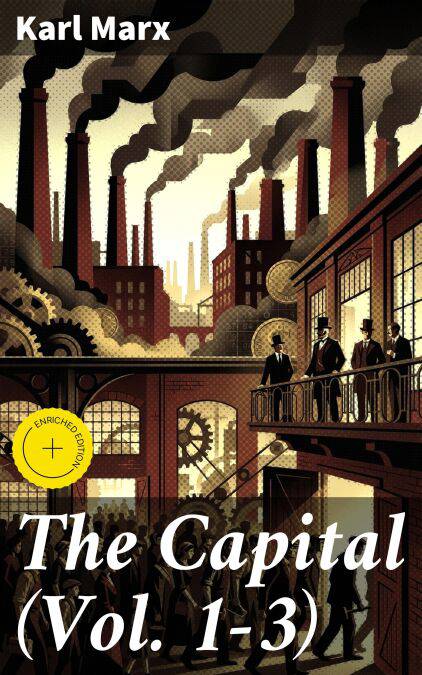
The Capital (Vol. 1-3) EBOOK
Enriched edition. Including The Communist Manifesto, Wage-Labour and Capital, & Wages, Price and Profit
Karl Marx
Ebook | Anglais
0,49 €
0,99 €
Format
Description
Karl Marx's monumental work, "The Capital" (Volumes 1-3), delves into the intricate mechanics of capitalist society, examining the relationship between labor, value, and capital accumulation. Written in a rigorous yet accessible style, Marx employs a dialectical approach to analyze the economic structures that underpin the capitalist mode of production. His exploration covers the commodification of labor, the exploitation inherent in surplus value, and the cyclical crises that capitalism engenders, all while contextualizing these phenomena within the broader historical framework of economic development. Marx, a philosopher, economist, and social theorist, was deeply influenced by the social and political upheavals of the 19th century, including the industrial revolution and the rise of the working class. His earlier writings, particularly the "Economic and Philosophic Manuscripts of 1844," laid the groundwork for his critical analysis in "The Capital." Through both his personal experiences in Europe and intellectual currents of his time, Marx developed a keen understanding of the struggles faced by the proletariat, motivating him to offer a comprehensive critique of capitalist society that extended beyond mere economic analysis. "The Capital" is an indispensable text for anyone seeking to understand the foundations of modern economics and the philosophical underpinnings of social theory. It not only outlines the complexities of capitalism but also provokes critical thought regarding its sustainability and moral implications. Scholars, students, and curious readers alike will find invaluable insights in Marx'Äôs rigorous examination of economic systems and their impact on human relations.
In this enriched edition, we have carefully created added value for your reading experience:
- A comprehensive Introduction outlines these selected works' unifying features, themes, or stylistic evolutions.
- The Author Biography highlights personal milestones and literary influences that shape the entire body of writing.
- A Historical Context section situates the works in their broader era—social currents, cultural trends, and key events that underpin their creation.
- A concise Synopsis (Selection) offers an accessible overview of the included texts, helping readers navigate plotlines and main ideas without revealing critical twists.
- A unified Analysis examines recurring motifs and stylistic hallmarks across the collection, tying the stories together while spotlighting the different work's strengths.
- Reflection questions inspire deeper contemplation of the author's overarching message, inviting readers to draw connections among different texts and relate them to modern contexts.
- Lastly, our hand‐picked Memorable Quotes distill pivotal lines and turning points, serving as touchstones for the collection's central themes.
In this enriched edition, we have carefully created added value for your reading experience:
- A comprehensive Introduction outlines these selected works' unifying features, themes, or stylistic evolutions.
- The Author Biography highlights personal milestones and literary influences that shape the entire body of writing.
- A Historical Context section situates the works in their broader era—social currents, cultural trends, and key events that underpin their creation.
- A concise Synopsis (Selection) offers an accessible overview of the included texts, helping readers navigate plotlines and main ideas without revealing critical twists.
- A unified Analysis examines recurring motifs and stylistic hallmarks across the collection, tying the stories together while spotlighting the different work's strengths.
- Reflection questions inspire deeper contemplation of the author's overarching message, inviting readers to draw connections among different texts and relate them to modern contexts.
- Lastly, our hand‐picked Memorable Quotes distill pivotal lines and turning points, serving as touchstones for the collection's central themes.
Spécifications
Parties prenantes
- Auteur(s) :
- Traducteur(s):
- Editeur:
Contenu
- Nombre de pages :
- 2151
- Langue:
- Anglais
Caractéristiques
- EAN:
- 8596547669395
- Date de parution :
- 16-11-23
- Format:
- Ebook
- Protection digitale:
- Digital watermarking
- Format numérique:
- ePub



Seulement chez Librairie Club
Cadeau


Les avis
Nous publions uniquement les avis qui respectent les conditions requises. Consultez nos conditions pour les avis.