


- Retrait en 2 heures
- Assortiment impressionnant
- Paiement sécurisé
- Toujours un magasin près de chez vous
- Retrait en 2 heures
- Assortiment impressionnant
- Paiement sécurisé
- Toujours un magasin près de chez vous



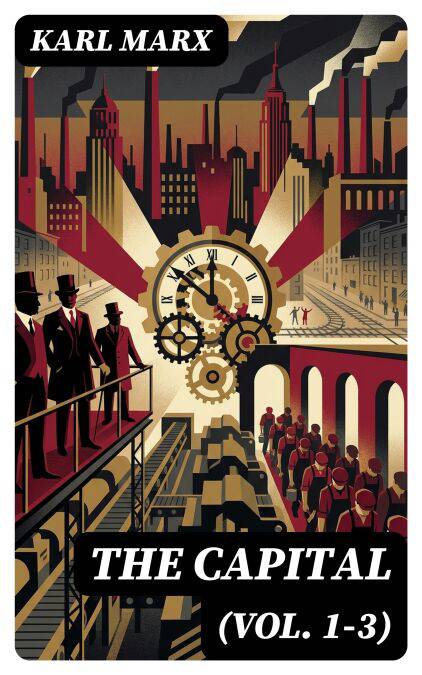
The Capital (Vol. 1-3) EBOOK
Enriched edition. Including The Communist Manifesto, Wage-Labour and Capital, & Wages, Price and Profit
Karl Marx
Ebook | Anglais
0,99 €
Format
Description
Karl Marx's "The Capital" (Volumes 1-3) is an exhaustive critique of political economy, particularly concentrating on the capitalist mode of production. Written in a rigorous and analytical style, the text combines historical analysis with logical examination, unveiling the intricate workings of capitalism and its inherent contradictions. Marx dissects the processes of commodity production, labor value, and capital accumulation, utilizing a dialectical method that situates economic phenomena within broader social and historical contexts. The work not only addresses the mechanics of capitalism but also anticipates the socioeconomic transformations that could arise from its own internal crises. Karl Marx, a philosopher, economist, and revolutionary socialist, was deeply affected by the social injustices and economic disparities of the 19th century. His experiences as a journalist in Germany and later in France and England illuminated the struggles of the working class. These insights, alongside his collaboration with Friedrich Engels and influence from Hegelian dialectics, culminated in "The Capital," where he synthesized his theoretical frameworks into a penetrating analysis of capitalist society. This seminal work is essential for readers seeking to understand the foundations of modern economic thought and social theory. "The Capital" not only provides profound insights into the nature of exploitation and class struggle but also challenges readers to critically engage with the economic structures that shape their lives. It is highly recommended for scholars, activists, and anyone interested in the dynamics of power and oppression in contemporary society.
In this enriched edition, we have carefully created added value for your reading experience:
- A comprehensive Introduction outlines these selected works' unifying features, themes, or stylistic evolutions.
- The Author Biography highlights personal milestones and literary influences that shape the entire body of writing.
- A Historical Context section situates the works in their broader era—social currents, cultural trends, and key events that underpin their creation.
- A concise Synopsis (Selection) offers an accessible overview of the included texts, helping readers navigate plotlines and main ideas without revealing critical twists.
- A unified Analysis examines recurring motifs and stylistic hallmarks across the collection, tying the stories together while spotlighting the different work's strengths.
- Reflection questions inspire deeper contemplation of the author's overarching message, inviting readers to draw connections among different texts and relate them to modern contexts.
- Lastly, our hand‐picked Memorable Quotes distill pivotal lines and turning points, serving as touchstones for the collection's central themes.
In this enriched edition, we have carefully created added value for your reading experience:
- A comprehensive Introduction outlines these selected works' unifying features, themes, or stylistic evolutions.
- The Author Biography highlights personal milestones and literary influences that shape the entire body of writing.
- A Historical Context section situates the works in their broader era—social currents, cultural trends, and key events that underpin their creation.
- A concise Synopsis (Selection) offers an accessible overview of the included texts, helping readers navigate plotlines and main ideas without revealing critical twists.
- A unified Analysis examines recurring motifs and stylistic hallmarks across the collection, tying the stories together while spotlighting the different work's strengths.
- Reflection questions inspire deeper contemplation of the author's overarching message, inviting readers to draw connections among different texts and relate them to modern contexts.
- Lastly, our hand‐picked Memorable Quotes distill pivotal lines and turning points, serving as touchstones for the collection's central themes.
Spécifications
Parties prenantes
- Auteur(s) :
- Traducteur(s):
- Editeur:
Contenu
- Nombre de pages :
- 2151
- Langue:
- Anglais
Caractéristiques
- EAN:
- 8596547753629
- Date de parution :
- 14-12-23
- Format:
- Ebook
- Protection digitale:
- Digital watermarking
- Format numérique:
- ePub



Seulement chez Librairie Club
Cadeau


Les avis
Nous publions uniquement les avis qui respectent les conditions requises. Consultez nos conditions pour les avis.