


En raison d'une grève chez bpost, des retards de livraison peuvent survenir. Besoin de quelque chose en urgence ? Optez pour un retrait en magasin ou rendez-vous dans une Librairie Club à proximité.
- Retrait en 2 heures
- Assortiment impressionnant
- Paiement sécurisé
- Toujours un magasin près de chez vous
En raison d'une grève chez bpost, des retards de livraison peuvent survenir. Besoin de quelque chose en urgence ? Optez pour un retrait en magasin ou rendez-vous dans une Librairie Club à proximité.
- Retrait en 2 heures
- Assortiment impressionnant
- Paiement sécurisé
- Toujours un magasin près de chez vous



Description
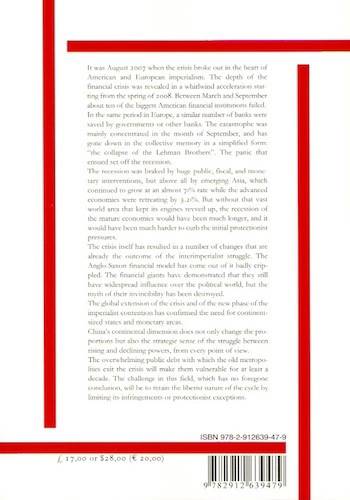
It was August 2007 when the crisis broke out in the heart of American and European imperialism. The depth of the financial crisis was revealed in a whirlwind acceleration starting from the spring of 2008. Between March and September about ten of the biggest American financial institutions failed.
In the same period in Europe, a similar number of banks were saved by governments or other banks. The catastrophe was mainly concentrated in the month of September, and has gone down in the collective memory in a simplified form: “the collapse of Lehman Brothers”. The panic that ensued set off the recession.
The recession was braked by huge public, fiscal, and monetary interventions, but above all by emerging Asia, which continued to grow at an almost 7% rate while the advanced economies were retreating by 3.2%. But without that vast world area that kept its engines revved up, the recession of the mature economies would have been much longer, and it would have been much harder to curb the initial protectionist pressures.
The crisis itself has resulted in a number of changes that are already the outcome of the interimperialist struggle. The Anglo-Saxon financial model has come out of it badly crippled.
The financial giants have demonstrated that they still have widespread influence over the political world, but the myth of their invincibility has been destroyed.
The global extension of the crisis and of the new phase of the imperialist contention has confirmed the need for continent-sized states and monetary areas.
China’s continental dimension dœs not only change the proportions but also the strategic sense of the struggle between rising and declining powers, from every point of view.
The overwhelming public debt with which the old metropolises exit the crisis will make them vulnerable for at least a decade. The challenge in this field, which has no foregone conclusion, will be to retain the liberist nature of the cycle by limiting its infringements or protectionist exceptions.
Crises lead to disappointment and disillusion, but also to fear and confusion. For the working class they are moments of suffering and of the need for clarity, moments that are difficult to overcome, because it is precisely in times of crisis that the bourgeoisie seeks to set proletarian against proletarian, setting the instinct for self-preservation against the instinct for solidarity. But it is self-evident that crises are the confession of the impotence of capitalism in the face of its contradictions, the recantation of its promises to the younger generations, and the unmasking of democracy before growing social disparity. Crises provide the best moment to reaffirm that our class numbers mean that we are strong only if we are guided by Marxist science and organisation.
In the same period in Europe, a similar number of banks were saved by governments or other banks. The catastrophe was mainly concentrated in the month of September, and has gone down in the collective memory in a simplified form: “the collapse of Lehman Brothers”. The panic that ensued set off the recession.
The recession was braked by huge public, fiscal, and monetary interventions, but above all by emerging Asia, which continued to grow at an almost 7% rate while the advanced economies were retreating by 3.2%. But without that vast world area that kept its engines revved up, the recession of the mature economies would have been much longer, and it would have been much harder to curb the initial protectionist pressures.
The crisis itself has resulted in a number of changes that are already the outcome of the interimperialist struggle. The Anglo-Saxon financial model has come out of it badly crippled.
The financial giants have demonstrated that they still have widespread influence over the political world, but the myth of their invincibility has been destroyed.
The global extension of the crisis and of the new phase of the imperialist contention has confirmed the need for continent-sized states and monetary areas.
China’s continental dimension dœs not only change the proportions but also the strategic sense of the struggle between rising and declining powers, from every point of view.
The overwhelming public debt with which the old metropolises exit the crisis will make them vulnerable for at least a decade. The challenge in this field, which has no foregone conclusion, will be to retain the liberist nature of the cycle by limiting its infringements or protectionist exceptions.
Crises lead to disappointment and disillusion, but also to fear and confusion. For the working class they are moments of suffering and of the need for clarity, moments that are difficult to overcome, because it is precisely in times of crisis that the bourgeoisie seeks to set proletarian against proletarian, setting the instinct for self-preservation against the instinct for solidarity. But it is self-evident that crises are the confession of the impotence of capitalism in the face of its contradictions, the recantation of its promises to the younger generations, and the unmasking of democracy before growing social disparity. Crises provide the best moment to reaffirm that our class numbers mean that we are strong only if we are guided by Marxist science and organisation.
Spécifications
Parties prenantes
- Auteur(s) :
- Editeur:
Contenu
- Nombre de pages :
- 384
- Langue:
- Anglais
Caractéristiques
- EAN:
- 9782912639479
- Date de parution :
- 01-04-11
- Format:
- Livre broché
- Dimensions :
- 150 mm x 210 mm
- Poids :
- 445 g



Seulement chez Librairie Club
+ 37 points sur votre carte client de Librairie Club
Cadeau


Les avis
Nous publions uniquement les avis qui respectent les conditions requises. Consultez nos conditions pour les avis.