


- Retrait en 2 heures
- Assortiment impressionnant
- Paiement sécurisé
- Toujours un magasin près de chez vous
- Retrait gratuit dans votre magasin Club
- 7.000.0000 titres dans notre catalogue
- Payer en toute sécurité
- Toujours un magasin près de chez vous



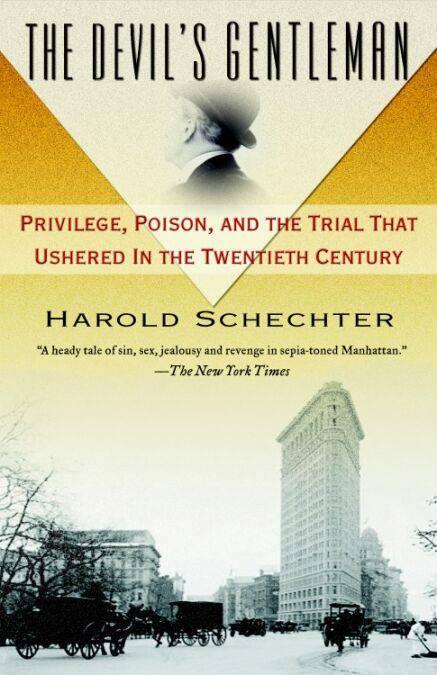
The Devil's Gentleman EBOOK
Privilege, Poison, and the Trial That Ushered in the Twentieth Century
Harold Schechter
Ebook | Anglais
11,51 €
+ 11 points
Format
Description
From renowned true-crime historian Harold Schechter, whom The Boston Book Review hails as “America’s principal chronicler of its greatest psychopathic killers,” comes the riveting exploration of a notorious, sensational New York City murder in the 1890s, the fascinating forensic science of an earlier age, and the explosively dramatic trial that became a tabloid sensation at the turn of the century.
Death was by poison and came in the mail: A package of Bromo Seltzer had been anonymously sent to Harry Cornish, the popular athletic director of Manhattan’s elite Knickerbocker Athletic Club. Cornish barely survived swallowing a small dose; his cousin Mrs. Katherine Adams died in agony after ingesting the toxic brew. Scandal sheets owned by Hearst and Pulitzer eagerly jumped on this story of fatal high-society intrigue, speculating that the devious killer was a chemist, a woman, or “an effeminate man.” Forensic studies suggested cyanide as the cause of death; handwriting on the deadly package and the vestige of a label glued to the bottle pointed to a handsome, athletic society scamp, Roland Molineux.
The wayward son of a revered Civil War general, Molineux had clashed bitterly with Cornish before. He had even furiously denounced Cornish when penning his resignation from the Knickerbocker Club, a letter that later proved a major clue. Bon vivant Molineux had recently wed the sensuous Blanche Chesebrough, an opera singer whose former lover, Henry Barnet, had also recently died . . . after taking medicine sent to him through the mail. Molineux’s subsequent indictment for murder led to two explosive trials, a sex-infused scandal that shocked the nation, and a lurid print-media circus that ended in madness and a proud family’s disgrace.
In bold, brilliant strokes, Schechter captures all the colors of the tumultuous legal case, gathering his own evidence and tackling subjects no one dared address at the time–all in hopes of answering the tantalizing question: What powerfully dark motives could drive the wealthy scion of an eminent New York family to foul murder?
Schechter vividly portrays the case’s fascinating cast of characters, including Julian Hawthorne, son of Nathaniel Hawthorne, a prolific yellow journalist who covered the story, and proud General Edward Leslie Molineux, whose son’s ignoble deeds besmirched a dignified national hero’s final years. All the while Schechter brings alive Manhattan’s Gilded Age: a gaslit world of elegant town houses and hidden bordellos, chic restaurants and shabby opium dens, a city peopled by men and women fighting and losing the battle against urges an upright era had ordered suppressed.
Superbly researched and powerfully written, The Devil’s Gentleman is an insightful, gripping work, a true-crime historian’s crowning achievement.
Death was by poison and came in the mail: A package of Bromo Seltzer had been anonymously sent to Harry Cornish, the popular athletic director of Manhattan’s elite Knickerbocker Athletic Club. Cornish barely survived swallowing a small dose; his cousin Mrs. Katherine Adams died in agony after ingesting the toxic brew. Scandal sheets owned by Hearst and Pulitzer eagerly jumped on this story of fatal high-society intrigue, speculating that the devious killer was a chemist, a woman, or “an effeminate man.” Forensic studies suggested cyanide as the cause of death; handwriting on the deadly package and the vestige of a label glued to the bottle pointed to a handsome, athletic society scamp, Roland Molineux.
The wayward son of a revered Civil War general, Molineux had clashed bitterly with Cornish before. He had even furiously denounced Cornish when penning his resignation from the Knickerbocker Club, a letter that later proved a major clue. Bon vivant Molineux had recently wed the sensuous Blanche Chesebrough, an opera singer whose former lover, Henry Barnet, had also recently died . . . after taking medicine sent to him through the mail. Molineux’s subsequent indictment for murder led to two explosive trials, a sex-infused scandal that shocked the nation, and a lurid print-media circus that ended in madness and a proud family’s disgrace.
In bold, brilliant strokes, Schechter captures all the colors of the tumultuous legal case, gathering his own evidence and tackling subjects no one dared address at the time–all in hopes of answering the tantalizing question: What powerfully dark motives could drive the wealthy scion of an eminent New York family to foul murder?
Schechter vividly portrays the case’s fascinating cast of characters, including Julian Hawthorne, son of Nathaniel Hawthorne, a prolific yellow journalist who covered the story, and proud General Edward Leslie Molineux, whose son’s ignoble deeds besmirched a dignified national hero’s final years. All the while Schechter brings alive Manhattan’s Gilded Age: a gaslit world of elegant town houses and hidden bordellos, chic restaurants and shabby opium dens, a city peopled by men and women fighting and losing the battle against urges an upright era had ordered suppressed.
Superbly researched and powerfully written, The Devil’s Gentleman is an insightful, gripping work, a true-crime historian’s crowning achievement.
Spécifications
Parties prenantes
- Auteur(s) :
- Editeur:
Contenu
- Nombre de pages :
- 512
- Langue:
- Anglais
Caractéristiques
- EAN:
- 9780345509420
- Date de parution :
- 29-09-08
- Format:
- Ebook
- Protection digitale:
- Adobe DRM
- Format numérique:
- ePub



Seulement chez Librairie Club
+ 11 points sur votre carte client de Librairie Club
Cadeau

Cadeau


Les avis
Nous publions uniquement les avis qui respectent les conditions requises. Consultez nos conditions pour les avis.