


- Retrait en 2 heures
- Assortiment impressionnant
- Paiement sécurisé
- Toujours un magasin près de chez vous
- Retrait gratuit dans votre magasin Club
- 7.000.0000 titres dans notre catalogue
- Payer en toute sécurité
- Toujours un magasin près de chez vous



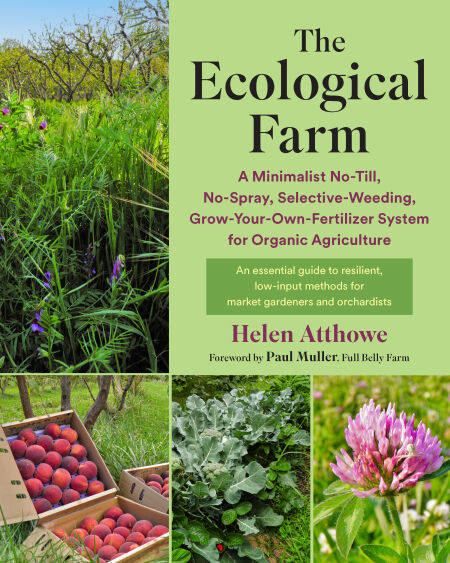
The Ecological Farm EBOOK
A Minimalist No-Till, No-Spray, Selective-Weeding, Grow-Your-Own-Fertilizer System for Organic Agriculture
Helen Atthowe
Ebook | Anglais
44,31 €
+ 44 points
Format
Description
The breakthrough resource for fruit and vegetable growers at every scale who want to go ‘beyond organic’ and build higher soil quality and fertility using fewer inputs through a unique ecosystem-balancing approach
“Atthowe’s book takes ecological farming to the next level. It is packed with useful, field-tested, innovative techniques for farming more gently without sacrificing productivity. . . This is the future of farming. I highly recommend this book.”—Ben Hartman, author of The Lean Farm
The Ecological Farm is the go-to guide for ecological growing, with a unique focus on reduced tillage, minimizing farm and garden inputs, and pest control.
Reflecting the wisdom that farmer, consultant, and educator Helen Atthowe and her late husband, Carl Rosato, gained during decades of farming experience, this book guides readers on how to reduce or eliminate the use of outside inputs of fertilizer or pesticides—even those that are commonly used on certified organic orchards and market gardens. In clear language and with color photographs, charts, and graphs throughout, the book emphasizes the importance of managing the details of an entire growing system over the full life of the enterprise.
Based on advances in scientific research in ecological food production, farmers, homesteaders, permaculturists, and gardeners alike will learn methods to:
design a farm system that maintains a growing root in the soil year-round to feed the microbial community instead of just crops. strengthen the “immune system” of a farm or garden supply crop needs using only on-farm inputs such as cover crops and living mulch maximize the presence of beneficial insects and microbes that support healthy crop development minimize ecological impact in dealing with insect pest and disease problems
The Ecological Farm also features a crop-by-crop guide to growing more than 25 of the most popular and profitable vegetables and fruits, including specific management advice for dealing with pests and diseases.
The Ecological Farm makes complex, sometimes messy, ecological concepts and practices understandable to all growers, and makes healthy farming—in which nature is invited to participate—possible.
“[This book] will guide all of us as we learn to farm in harmony with an ecosystem and to become obedient to the whole rather than being distracted by the urge to tinker with the parts.”
—Wes Jackson, cofounder and president emeritus, The Land Institute
“Atthowe’s book takes ecological farming to the next level. It is packed with useful, field-tested, innovative techniques for farming more gently without sacrificing productivity. . . This is the future of farming. I highly recommend this book.”—Ben Hartman, author of The Lean Farm
The Ecological Farm is the go-to guide for ecological growing, with a unique focus on reduced tillage, minimizing farm and garden inputs, and pest control.
Reflecting the wisdom that farmer, consultant, and educator Helen Atthowe and her late husband, Carl Rosato, gained during decades of farming experience, this book guides readers on how to reduce or eliminate the use of outside inputs of fertilizer or pesticides—even those that are commonly used on certified organic orchards and market gardens. In clear language and with color photographs, charts, and graphs throughout, the book emphasizes the importance of managing the details of an entire growing system over the full life of the enterprise.
Based on advances in scientific research in ecological food production, farmers, homesteaders, permaculturists, and gardeners alike will learn methods to:
design a farm system that maintains a growing root in the soil year-round to feed the microbial community instead of just crops. strengthen the “immune system” of a farm or garden supply crop needs using only on-farm inputs such as cover crops and living mulch maximize the presence of beneficial insects and microbes that support healthy crop development minimize ecological impact in dealing with insect pest and disease problems
The Ecological Farm also features a crop-by-crop guide to growing more than 25 of the most popular and profitable vegetables and fruits, including specific management advice for dealing with pests and diseases.
The Ecological Farm makes complex, sometimes messy, ecological concepts and practices understandable to all growers, and makes healthy farming—in which nature is invited to participate—possible.
“[This book] will guide all of us as we learn to farm in harmony with an ecosystem and to become obedient to the whole rather than being distracted by the urge to tinker with the parts.”
—Wes Jackson, cofounder and president emeritus, The Land Institute
Spécifications
Parties prenantes
- Auteur(s) :
- Editeur:
Contenu
- Nombre de pages :
- 384
- Langue:
- Anglais
Caractéristiques
- EAN:
- 9781645021827
- Date de parution :
- 21-06-23
- Format:
- Ebook
- Protection digitale:
- Adobe DRM
- Format numérique:
- ePub


Seulement chez Librairie Club
+ 44 points sur votre carte client de Librairie Club
Cadeau

Cadeau


Les avis
Nous publions uniquement les avis qui respectent les conditions requises. Consultez nos conditions pour les avis.