


- Retrait en 2 heures
- Assortiment impressionnant
- Paiement sécurisé
- Toujours un magasin près de chez vous
- Retrait en 2 heures
- Assortiment impressionnant
- Paiement sécurisé
- Toujours un magasin près de chez vous



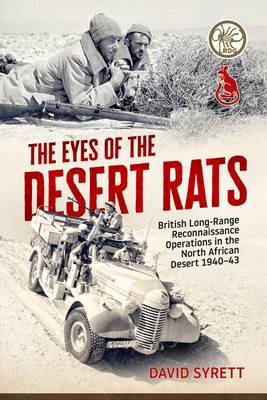
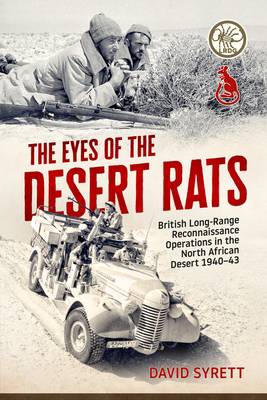
The Eyes of the Desert Rats
British Long-Range Reconnaissance Operations in the North African Desert 1940-43
David Syrett
Livre broché | Anglais
41,95 €
+ 83 points
Description
Made up of members of the Coldstream and Scots Guards, British yeomanry cavalry regiments, New Zealanders, South Africans, and Indian Army men, the Long Range Desert Group was perhaps the most effective of all the "special forces" established by the Allies during the Second World War. It was able to go thousands of miles into enemy territory, well-armed and carrying its own supplies of petrol, food and even water to last for weeks at a time - something quite new in military history.
Using experience acquired in WWI and interwar exploration travels, the LRDG thus developed the ability to appear almost anywhere in the desert to carry out almost every type of ground reconnaissance mission possible in desert warfare, exploring and mapping the terrain, transporting agents behind enemy lines or determining the strength and location of enemy forces with an extraordinary degree of accuracy and detail and thus able to verify or hide Ultra intelligence. Equally important were their skills in the art of desert navigation, demonstrated in the outflanking of the enemy during the Allied advance from El Alamein westward to Tunisia, as led by the LRDG. Once it had teamed up with the Special Air Service (SAS), made up of British, Free French, Commonwealth and Jewish Palestinian soldiers, the LRDG perfected the art of irregular mechanized warfare conducted in the rear of the enemy's forces in the desert, attacking enemy installations of all kinds, mining roads, raiding airfields, destroying enemy aircraft on the ground and inflicting losses upon the enemy in inverse proportion to their own remarkably low rate of casualties.
Through meticulous research in original archival material, this book thus tells the extraordinary story of how a relatively small number of dedicated men developed the methods and techniques for crossing by motor vehicle the depths of the then unmapped and seemingly impassable great deserts of Egypt and Libya, the Western Desert, during the British Army's North African Campaign of 1940-43.
The Long Range Desert Group and the Special Air Service as a matter of course did extraordinary things - the heroic was the commonplace. Their tactics, techniques and remarkable success in desert warfare continue to make them of great interest to the student of military affairs. Likewise, as it seeks to answer how the deep desert can best be used for military purposes, this study is pertinent to today's military operations, perhaps more so than at any time since World War II.
Using experience acquired in WWI and interwar exploration travels, the LRDG thus developed the ability to appear almost anywhere in the desert to carry out almost every type of ground reconnaissance mission possible in desert warfare, exploring and mapping the terrain, transporting agents behind enemy lines or determining the strength and location of enemy forces with an extraordinary degree of accuracy and detail and thus able to verify or hide Ultra intelligence. Equally important were their skills in the art of desert navigation, demonstrated in the outflanking of the enemy during the Allied advance from El Alamein westward to Tunisia, as led by the LRDG. Once it had teamed up with the Special Air Service (SAS), made up of British, Free French, Commonwealth and Jewish Palestinian soldiers, the LRDG perfected the art of irregular mechanized warfare conducted in the rear of the enemy's forces in the desert, attacking enemy installations of all kinds, mining roads, raiding airfields, destroying enemy aircraft on the ground and inflicting losses upon the enemy in inverse proportion to their own remarkably low rate of casualties.
Through meticulous research in original archival material, this book thus tells the extraordinary story of how a relatively small number of dedicated men developed the methods and techniques for crossing by motor vehicle the depths of the then unmapped and seemingly impassable great deserts of Egypt and Libya, the Western Desert, during the British Army's North African Campaign of 1940-43.
The Long Range Desert Group and the Special Air Service as a matter of course did extraordinary things - the heroic was the commonplace. Their tactics, techniques and remarkable success in desert warfare continue to make them of great interest to the student of military affairs. Likewise, as it seeks to answer how the deep desert can best be used for military purposes, this study is pertinent to today's military operations, perhaps more so than at any time since World War II.
Spécifications
Parties prenantes
- Auteur(s) :
- Editeur:
Contenu
- Nombre de pages :
- 330
- Langue:
- Anglais
Caractéristiques
- EAN:
- 9781806721313
- Date de parution :
- 15-10-26
- Format:
- Livre broché
- Format numérique:
- Trade paperback (VS)
- Dimensions :
- 155 mm x 234 mm


Seulement chez Librairie Club
+ 83 points sur votre carte client de Librairie Club
Cadeau


Les avis
Nous publions uniquement les avis qui respectent les conditions requises. Consultez nos conditions pour les avis.