


- Retrait en 2 heures
- Assortiment impressionnant
- Paiement sécurisé
- Toujours un magasin près de chez vous
- Retrait gratuit dans votre magasin Club
- 7.000.0000 titres dans notre catalogue
- Payer en toute sécurité
- Toujours un magasin près de chez vous

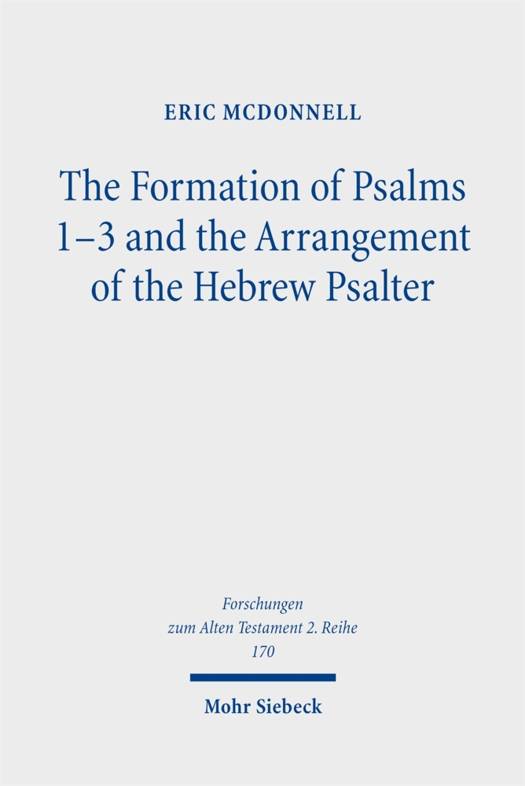
The Formation of Psalms 13 and the Arrangement of the Hebrew Psalter
Eric McDonnell
93,95 €
+ 187 points
Description
English summary: Eric McDonnell offers a detailed analysis of the literary functions of the three psalms that open the Masoretic Psalter, employing diachronic, comparative and literary-theoretical methods. Beginning with a discussion of the preface in the sense articulated by Jacques Derrida and Gerard Genette, the author distinguishes primary, introductory and prefatorial functions that texts may assume at the threshold of larger compositions. On this basis, Ps 1 and 2 appear as a two-part prefatorial paratext shaping the literary and theological orientation of the emerging Psalter, while Ps 3 serves a different function by introducing the general form of the individual lament, reflecting an early preexilic stage of the collection. A comparative examination of the Gilgamesh Epic, the Egyptian Book of the Dead and Sirach shows how ancient textual collections reuse traditional materials to advance new literary and ideological purposes, a process described as iterative play in conversation with Derrida and Hans-Georg Gadamer. The author then reviews three influential accounts of the literary development of the Masoretic Psalter and presents an alternative reconstruction that builds on the preceding analyses. Eric McDonnell thus highlights the close relation between synchronic readings and diachronic analysis and demonstrates how both perspectives contribute to understanding the shape and shaping of the Masoretic Psalter. German description: Eric McDonnell unternimmt eine detaillierte Analyse der literarischen Funktionen der drei Psalmen, die den masoretischen Psalter eroffnen, wobei er diachrone, vergleichende und literaturtheoretische Methoden anwendet. Ausgehend von einer Diskussion des Vorworts im Sinne von Jacques Derrida und Gerard Genette unterscheidet der Autor zwischen primaren, einleitenden und vorwortartigen Funktionen, die Texte am Anfang grosserer Kompositionen ubernehmen konnen. Auf dieser Grundlage erscheinen Ps 1 und 2 als zweiteiliger prafatorischer Paratext, der die literarische und theologische Ausrichtung des entstehenden Psalters pragt, wahrend Ps 3 eine andere Funktion erfullt, indem er die allgemeine Form der individuellen Klage einfuhrt und damit eine fruhe vorsexilische Phase der Sammlung widerspiegelt. Eine vergleichende Untersuchung des Gilgamesch-Epos, des agyptischen Totenbuchs und des Sirach zeigt, wie alte Textsammlungen traditionelles Material wiederverwenden, um neue literarische und ideologische Ziele zu verfolgen, ein Prozess, der im Dialog mit Derrida und Hans-Georg Gadamer als iteratives Spiel beschrieben wird. Der Autor untersucht anschliessend drei einflussreiche Darstellungen der literarischen Entwicklung des masoretischen Psalters und prasentiert eine alternative Rekonstruktion, die auf den vorangegangenen Analysen aufbaut. Eric McDonnell hebt somit die enge Beziehung zwischen synchronen Lesarten und diachroner Analyse hervor und zeigt, wie beide Perspektiven zum Verstandnis der Form und Gestaltung des masoretischen Psalters beitragen.
Spécifications
Parties prenantes
- Auteur(s) :
- Editeur:
Contenu
- Nombre de pages :
- 270
- Langue:
- Anglais
- Collection :
Caractéristiques
- EAN:
- 9783161642524
- Date de parution :
- 31-03-26
- Format:
- Livre broché
- Format numérique:
- Trade paperback (VS)
- Dimensions :
- 155 mm x 231 mm
- Poids :
- 231 g


Seulement chez Librairie Club
+ 187 points sur votre carte client de Librairie Club
Cadeau

Cadeau


Les avis
Nous publions uniquement les avis qui respectent les conditions requises. Consultez nos conditions pour les avis.