


- Retrait en 2 heures
- Assortiment impressionnant
- Paiement sécurisé
- Toujours un magasin près de chez vous
- Retrait en 2 heures
- Assortiment impressionnant
- Paiement sécurisé
- Toujours un magasin près de chez vous



83,45 €
+ 166 points
Description
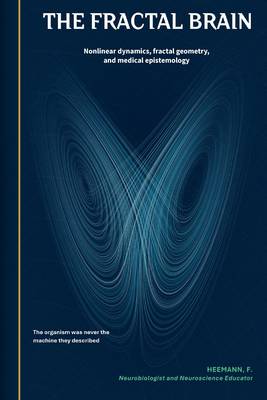
Clinical medicine inherited a mathematics built for planets and clocks - linear, reversible, equilibrium-seeking - and applied it to organisms that are none of these things. The Fractal Brain is a systematic demolition of that inheritance.
Drawing on dissipative structure theory, fractal geometry, and nonlinear dynamics, the book demonstrates that the living organism is not a near-equilibrium system amenable to parametric description. It is a far-from-equilibrium dissipative structure with fractal architecture, operating at the edge of chaos, constituted by a trajectory through a high-dimensional phase space rather than by any instantaneous configuration of measurable parameters. Health is not the proximity of those parameters to a population mean. It is the complexity of the system's dynamics - its normative capacity, in Georges Canguilhem's precise sense: the organism's power to establish new norms in response to changed conditions.
The argument moves through four inflections. The first establishes the epistemological anomaly: the mathematical framework clinical medicine employs is categorically wrong for its object, not imprecise or awaiting refinement, but constituted within a geometry the organism does not inhabit. The second specifies the geometry of the error with the instruments adequate to it - Lyapunov exponents, fractal dimension, transfer entropy, the edge of chaos. The third exposes the phenomenological dimension of the failure, drawing on Merleau-Ponty, Heidegger, Wittgenstein, and Canguilhem to demonstrate that the framework reduces its object at four independent layers, losing constitutive features at each. The fourth identifies the sociological mechanism that ensures the framework reproduces itself despite the evidence against it, and begins the constructive work: a description of what the organism actually is when the laplacian grammar no longer determines the answer in advance.
This book does not propose a new clinical protocol. It diagnoses an epistemological anomaly with the precision that makes reconstruction conceivable. The reconstruction belongs to those whose empirical authority philosophy cannot claim.
Written for physicians, biologists, psychologists, and philosophers of science with the formation to receive Prigogine, Mandelbrot, and Merleau-Ponty as instruments rather than authorities requiring introduction.
Spécifications
Parties prenantes
- Auteur(s) :
- Editeur:
Contenu
- Nombre de pages :
- 208
- Langue:
- Anglais
- Collection :
- Tome:
- n° 8
Caractéristiques
- EAN:
- 9786598812676
- Date de parution :
- 08-04-2026
- Format:
- Livre broché
- Format numérique:
- Trade paperback (VS)
- Dimensions :
- 152 mm x 229 mm
- Poids :
- 381 g


Seulement chez Librairie Club
+ 166 points sur votre carte client de Librairie Club
Cadeau


Les avis
Nous publions uniquement les avis qui respectent les conditions requises. Consultez nos conditions pour les avis.