


- Retrait en 2 heures
- Assortiment impressionnant
- Paiement sécurisé
- Toujours un magasin près de chez vous
- Retrait gratuit dans votre magasin Club
- 7.000.0000 titres dans notre catalogue
- Payer en toute sécurité
- Toujours un magasin près de chez vous



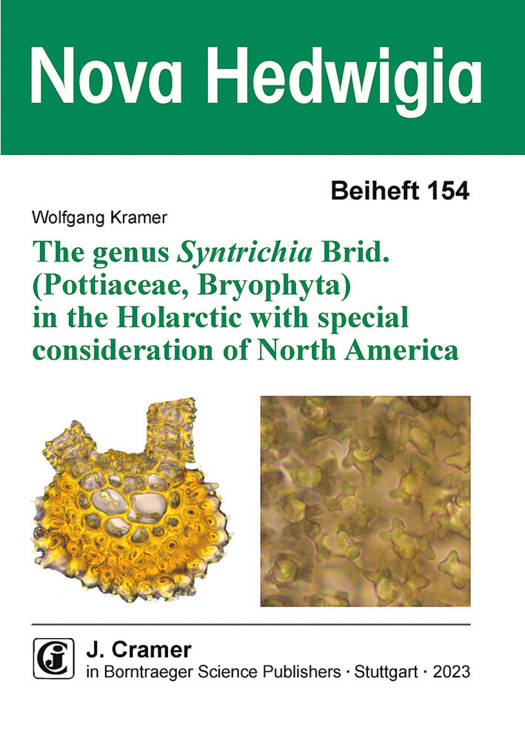
The genus Syntrichia Brid. (Pottiaceae, Bryophyta) in the Holarctic with special consideration of North America
Wolfgang Kramer
127,45 €
+ 254 points
Description
This volume 154 is the first comprehensive treatment of the genus Syntrichia in the Holarctic. Syntrichia (Pottiaceae, Bryophyta) is a genus with a large number of species existing on all continents. Some of the taxa are difficult to distinguish. Many names had to be reclassified taxonomically. The main focus of this work is on the species present in North America as those are often not well understood. Because the Holarctic part of Eurasia is connected to North America, the species of the entire extra-tropical Northern Hemisphere are studied. About 110 taxa are examined. The studies resulted in 34 species with 59 taxa of Syntrichia and three species which had to be assigned to other genera. Sixteen of the 59 taxa are new to science (five new species, four of them restricted to the Americas, one also existing in Eurasia; four other new taxa are restricted to North America, five to Eurasia, and two are present both in North America and in Eurasia). Three names previously treated as synonyms of other species are recognized as good species (one restricted to North America, two also in Eurasia). Twenty-four other names were designated as new synonyms for other taxa. In addition to the descriptions of taxa and an identification key, several characteristics (some of them new) are given that may be relevant to a division within the genus Syntrichia. This work is an important resource for bryologists specifically dealing with species of North America, but also of Europe and Asia. It is a great help for the identification of all taxa of Syntrichia in the Holarctic. It also serves as a basis for molecular-genetic studies on the genus Syntrichia and related genera.
Spécifications
Parties prenantes
- Auteur(s) :
- Editeur:
Contenu
- Nombre de pages :
- 234
- Langue:
- Anglais
- Collection :
- Tome:
- n° 154
Caractéristiques
- EAN:
- 9783443510831
- Format:
- Livre broché
- Dimensions :
- 170 mm x 240 mm
- Poids :
- 570 g


Seulement chez Librairie Club
+ 254 points sur votre carte client de Librairie Club
Cadeau

Cadeau


Les avis
Nous publions uniquement les avis qui respectent les conditions requises. Consultez nos conditions pour les avis.