


- Retrait en 2 heures
- Assortiment impressionnant
- Paiement sécurisé
- Toujours un magasin près de chez vous
- Retrait gratuit dans votre magasin Club
- 7.000.0000 titres dans notre catalogue
- Payer en toute sécurité
- Toujours un magasin près de chez vous



34,95 €
+ 69 points
Format
Description
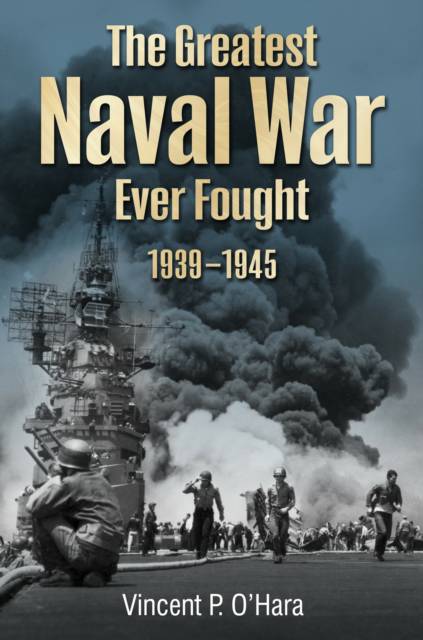
The greatest naval conflict in history was unquestionably that which took place during the Second World War. The geographical spread was global and involved dozens of nations, and it was a conflict that involved more than 15,000 ships and 43.7 million tons of shipping, while some 570,000 lives were lost at sea. Vince O'Hara captures every aspect of that vast naval conflict and provides a complete and panoramic single-volume history.
The naval action begins in the Baltic Sea before dawn on 1 September 1939, when a German battleship opened fire on Polish troops barricaded in a fortress in the port city of Danzig, Poland. Over the ensuing nine months, the conflict spread into Great Britain's home waters of the North Sea, the English Channel, and the eastern Atlantic; and in that theatre the battle against the U-boat grew into one of the most epic aspects of the whole war. One of the most remarkable naval achievements of the war occurred in 1940 during the German invasion of Norway when the Kriegsmarine's successful attack in the face of immensely superior Allied naval forces signalled the advent of large-scale amphibious operations. As naval activities in Europe expanded into the Mediterranean, the war in the Pacific ignited with the Japanese attack on Pearl Harbor in December 1941, an assault that led to a series of critical naval battles between Japan and the United States, including Wake Island, Coral Sea, Midway, and Guadalcanal.
O'Hara not only deftly examines all the major naval contests in the European and Pacific theatres but also offers detailed analysis of secondary navies such as France, Italy, and the Soviet Union. He explores little-known, smaller engagements such as the campaigns between Thailand and France or Perú and Ecuador. He also connects this broad range of naval action by focussing on recurring themes such as technological innovation, command and control, logistics, and intelligence. And he shows that the most significant naval platforms to emerge from the war, and which gave the Allies victory, were the oiler, the Landing Ship Tank (LST), and the Liberty ship--not the aircraft carrier, the submarine, or the battleship. And, finally, he demonstrates to readers how the impact of the naval battles won by the Allies still reverberates today.
The naval action begins in the Baltic Sea before dawn on 1 September 1939, when a German battleship opened fire on Polish troops barricaded in a fortress in the port city of Danzig, Poland. Over the ensuing nine months, the conflict spread into Great Britain's home waters of the North Sea, the English Channel, and the eastern Atlantic; and in that theatre the battle against the U-boat grew into one of the most epic aspects of the whole war. One of the most remarkable naval achievements of the war occurred in 1940 during the German invasion of Norway when the Kriegsmarine's successful attack in the face of immensely superior Allied naval forces signalled the advent of large-scale amphibious operations. As naval activities in Europe expanded into the Mediterranean, the war in the Pacific ignited with the Japanese attack on Pearl Harbor in December 1941, an assault that led to a series of critical naval battles between Japan and the United States, including Wake Island, Coral Sea, Midway, and Guadalcanal.
O'Hara not only deftly examines all the major naval contests in the European and Pacific theatres but also offers detailed analysis of secondary navies such as France, Italy, and the Soviet Union. He explores little-known, smaller engagements such as the campaigns between Thailand and France or Perú and Ecuador. He also connects this broad range of naval action by focussing on recurring themes such as technological innovation, command and control, logistics, and intelligence. And he shows that the most significant naval platforms to emerge from the war, and which gave the Allies victory, were the oiler, the Landing Ship Tank (LST), and the Liberty ship--not the aircraft carrier, the submarine, or the battleship. And, finally, he demonstrates to readers how the impact of the naval battles won by the Allies still reverberates today.
Spécifications
Parties prenantes
- Auteur(s) :
- Editeur:
Contenu
- Nombre de pages :
- 440
- Langue:
- Anglais
Caractéristiques
- EAN:
- 9781036153106
- Date de parution :
- 30-03-26
- Format:
- Livre relié
- Format numérique:
- Genaaid
- Dimensions :
- 159 mm x 235 mm
- Poids :
- 722 g


Seulement chez Librairie Club
+ 69 points sur votre carte client de Librairie Club
Cadeau

Cadeau


Les avis
Nous publions uniquement les avis qui respectent les conditions requises. Consultez nos conditions pour les avis.