


- Retrait en 2 heures
- Assortiment impressionnant
- Paiement sécurisé
- Toujours un magasin près de chez vous
- Retrait gratuit dans votre magasin Club
- 7.000.0000 titres dans notre catalogue
- Payer en toute sécurité
- Toujours un magasin près de chez vous



59,45 €
+ 118 points
Description
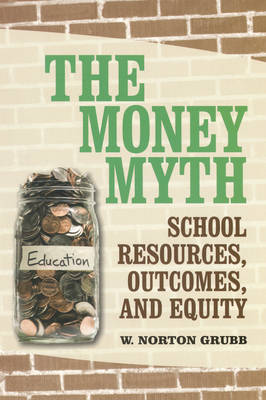
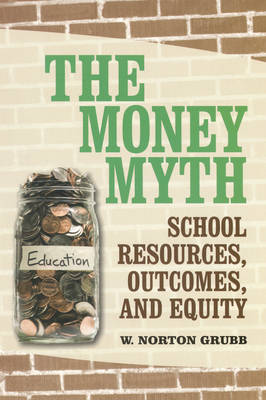
Can money buy high-quality education? Studies find only a weak relationship between public school funding and educational outcomes. In The Money Myth, W. Norton Grubb proposes a powerful paradigm shift in the way we think about why some schools thrive and others fail. The greatest inequalities in America's schools lie in factors other than fiscal support. Fundamental differences in resources other than money--for example, in leadership, instruction, and tracking policies--explain the deepening divide in the success of our nation's schoolchildren. The Money Myth establishes several principles for a bold new approach to education reform. Drawing on a national longitudinal dataset collected over twelve years, Grubb makes a crucial distinction between "simple" resources and those "compound," "complex," and "abstract" resources that cannot be readily bought. Money can buy simple resources--such as higher teacher salaries and smaller class sizes--but these resources are actually some of the weakest predictors of educational outcomes. On the other hand, complex resources pertaining to school practices are astonishingly strong predictors of success. Grubb finds that tracking policies have the most profound and consistent impact on student outcomes over time. Schools often relegate low-performing students--particularly minorities--to vocational, remedial, and special education tracks. So even in well-funded schools, resources may never reach the students who need them most. Grubb also finds that innovation in the classroom has a critical impact on student success. Here, too, America's schools are stratified. Teachers in underperforming schools tend to devote significant amounts of time to administration and discipline, while instructors in highly ranked schools dedicate the bulk of their time to "engaged learning," using varied pedagogical approaches. Effective schools distribute leadership among many instructors and administrators, and they foster a sense of both trust and accountability. These schools have a clear mission and coherent agenda for reaching goals. Underperforming schools, by contrast, implement a variety of fragmented reforms and practices without developing a unified plan. This phenomenon is perhaps most powerfully visible in the negative repercussions of No Child Left Behind. In a frantic attempt to meet federal standards and raise test scores quickly, more and more schools are turning to scripted "off the shelf" curricula. These practices discourage student engagement, suppress teacher creativity, and hold little promise of improving learning beyond the most basic skills. Grubb shows that infusions of money alone won't eradicate inequality in America's schools. We need to address the vast differences in the way school communities operate. By looking beyond school finance, The Money Myth gets to the core reasons why education in America is so unequal and provides clear recommendations for addressing this chronic national problem.
Spécifications
Parties prenantes
- Auteur(s) :
- Editeur:
Contenu
- Nombre de pages :
- 416
- Langue:
- Anglais
Caractéristiques
- EAN:
- 9780871540430
- Date de parution :
- 01-01-11
- Format:
- Livre broché
- Format numérique:
- Trade paperback (VS)
- Dimensions :
- 154 mm x 227 mm
- Poids :
- 603 g


Seulement chez Librairie Club
+ 118 points sur votre carte client de Librairie Club
Cadeau

Cadeau


Les avis
Nous publions uniquement les avis qui respectent les conditions requises. Consultez nos conditions pour les avis.