


- Retrait en 2 heures
- Assortiment impressionnant
- Paiement sécurisé
- Toujours un magasin près de chez vous
- Retrait en 2 heures
- Assortiment impressionnant
- Paiement sécurisé
- Toujours un magasin près de chez vous



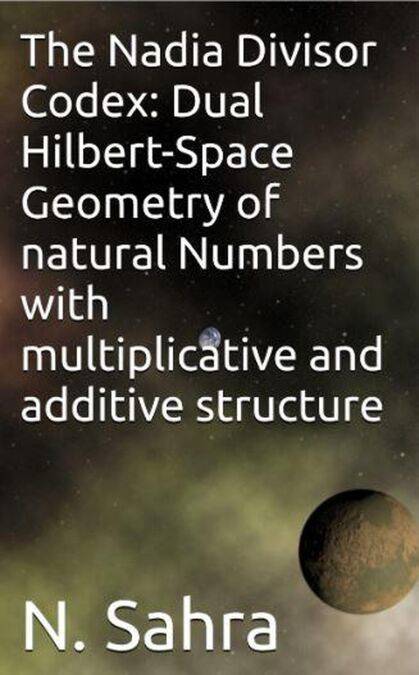
The Nadia Divisor Codex: Dual Hilbert-Space Geometry of Natural Numbers with Multiplicative and Additive Structure EBOOK
TrendFusion Hub, Nadia Sahraoui
Ebook | Anglais
10,49 €
+ 10 points
Description
Mathematical Content
Each integer n ∈ ℕ is represented by two canonical normalized states in ℓ²(ℕ):
Multiplicative state: |ψₙ⟩ = (1/√d(n)) Σ_{d|n} |d⟩, where d(n) denotes the divisor count function Additive state: |φₙ⟩ = (1/√(n-1)) Σ_{k=1}^{n-1} |k⟩Both representations induce inner products and Fubini-Study distances on ℕ.
Proven Results
The framework establishes five main theorems:
The divisor kernel K(n,m) = d(gcd(n,m)) is positive-definite on ℕ The multiplicative distance d_mult(n,m) = √(2 - 2⟨ψₙ|ψₘ⟩) satisfies metric axioms The additive distance d_add(n,m) = √(2 - 2⟨φₙ|φₘ⟩) satisfies metric axioms The combined distance d_codex(n,m) = √(α·d_mult² + β·d_add²) is a metric for α,β ≥ 0 The multiplicative entropy S_mult(n) = log₂(d(n)) equals the bipartite von Neumann entropy of |ψₙ⟩All theorems are proven using standard techniques from functional analysis and number theory.
Computational Implementation
The work includes complete algorithmic implementations with computational complexity O(√n) for:
Divisor enumeration Inner product calculation Distance matrix computation Entropy calculation Network construction Clustering algorithmsMathematical Mappings
The framework provides exact correspondences between arithmetic structure and:
Quantum state spaces (via Hilbert space embedding) Discrete energy spectra (via divisor-indexed levels) Crystallographic lattices (via prime factorization) Information encoding capacity (via entropy measures)These are mathematical correspondences, not physical models.
Applications
The codex enables:
Geometric analysis of number-theoretic properties Network-based study of divisibility relationships Clustering of integers by arithmetic structure Distance-based classification methods Graph-theoretic approaches to multiplicative number theorySpécifications
Parties prenantes
- Auteur(s) :
- Editeur:
Contenu
- Langue:
- Anglais
Caractéristiques
- EAN:
- 9798233617133
- Date de parution :
- 22-12-25
- Format:
- Ebook
- Protection digitale:
- /
- Format numérique:
- ePub


Seulement chez Librairie Club
+ 10 points sur votre carte client de Librairie Club
Cadeau


Les avis
Nous publions uniquement les avis qui respectent les conditions requises. Consultez nos conditions pour les avis.