


- Retrait en 2 heures
- Assortiment impressionnant
- Paiement sécurisé
- Toujours un magasin près de chez vous
- Retrait en 2 heures
- Assortiment impressionnant
- Paiement sécurisé
- Toujours un magasin près de chez vous



Description
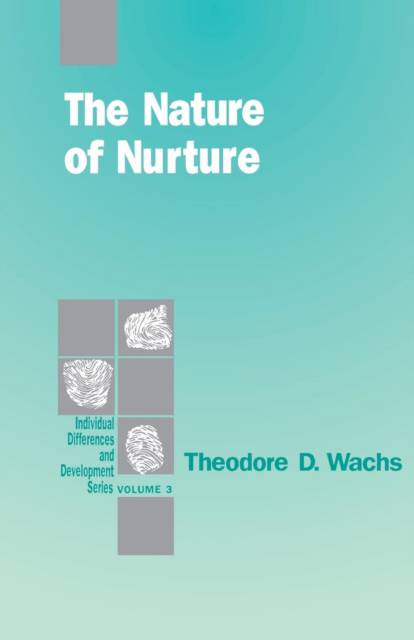
Are there certain periods in a child′s development when he or she may be more sensitive to specific environmental influences than at earlier or later times? Are preschool teachers equally nurturant to securely attached versus insecurely attached children? Are girls more sensitive than boys to parental maltreatment? Designed to synthesize what we know about the nature of environmental influences (nurture) upon development, Wachs artfully explores whether development depends upon a sole factor--the rearing environment, genetics, nutrition, or individual characteristics-- or, whether the degree of directional consistency combined with the extent of covariance among these factors may have the most developmental impact. Issues such as how individuals respond differently to stress, medical treatment, parenting styles, teaching approaches and daycare centers are all discussed through careful analysis of research and theories from a variety of fields. Researchers, teachers, and intervention specialists of developmental psychology, family studies, social psychology, education, and nursing will find The Nature of Nurture an inspiration to further examine how environmental systems determine variability in developmental outcomes and what can be done to promote optimal outcomes for individual children. USE IN NEXT AD (2/1/94): "In The Nature of Nurture Wachs does precisely what he intends to do. He lays out clearly and thoroughly what we know and do not know about environmental influences on human development, and he builds on the conceptual and empirical work of others to move research on environmental effects forward in productive and exciting ways. . . . [It] should serve as a bible for future research on the environment and development. As such, it is a must read for developmental psychologists from all specialty areas, to graduate students, and to upper level undergraduates. This is an eminently readable and important book." --Contemporary Psychology "The Nature of Nurture provides a thorough and thoughtful review and analysis of state-of-the-art theory, concepts, and evidence pertaining to the effect of the environment on human development. Especially important is the attention the author pays to the multidimensional nature of the environment, to individual differences among children, and to the need to consider both of these domains of complexity for understanding the development of specific aspects of psychological and behavioral functioning." --Jay Belsky, The Pennsylvania State University "The Nature of Nurture provides extended treatments of issues rarely dealt with in detail, including organism-environment covariance and organism-environment interaction. All in all, this is an excellent choice for those interested in studying complex, dynamic interplay of organism and environment. It deals with a number of critical design and theory issues; and it ends with a hybrid ecological developmental model designed to integrate studies of experience and offers a useful discussion of future trends in an emerging area of developmental studies." --Child Development Abstracts & Bibliography
Spécifications
Parties prenantes
- Auteur(s) :
- Editeur:
Contenu
- Nombre de pages :
- 208
- Langue:
- Anglais
- Collection :
- Tome:
- n° 3
Caractéristiques
- EAN:
- 9780803943759
- Date de parution :
- 26-08-92
- Format:
- Livre broché
- Format numérique:
- Trade paperback (VS)
- Dimensions :
- 137 mm x 213 mm
- Poids :
- 294 g



Seulement chez Librairie Club
+ 384 points sur votre carte client de Librairie Club
Cadeau


Les avis
Nous publions uniquement les avis qui respectent les conditions requises. Consultez nos conditions pour les avis.