


- Retrait en 2 heures
- Assortiment impressionnant
- Paiement sécurisé
- Toujours un magasin près de chez vous
- Retrait en 2 heures
- Assortiment impressionnant
- Paiement sécurisé
- Toujours un magasin près de chez vous



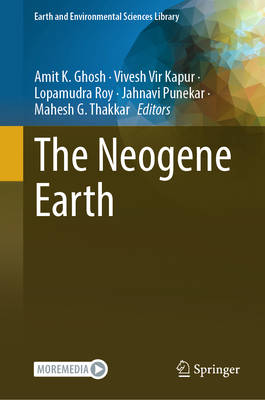
The Neogene Earth
216,95 €
+ 433 points
Description
This book not only serves the researchers for future studies but also an important textbook for the graduate and post graduate students who are keen in pursuing their career in past climate research and climate modelling.
There is an increased concern within the international scientific community regarding the global climatic variability in the present day Earth. This has simulated the scientists dealing with different aspects of climate research. In this context, the reconstruction of past climate is a useful tool for the prediction of future climatic changes because for better understanding of the future, a critical observation of the past is needed. Instrumental records of the climate are available for the last few centuries but not on a geological scale. Sediments deposited on the Earth archive different signatures in the form of different proxies namely geological features, fossils (both micro and macro), traces, geochemical parameters, etc. and these are useful to interpret past environment and climatic changes. In having the present scenario of global warming, it is highly important that we should interpret the past climatic events for better prediction of the future climate. If we consider the future climate projections is true, the climate of the Neogene Period can be one of the best analogues. During the Miocene Epoch of the Neogene Period, several major important climatic events took place, e.g. the Miocene Climatic Optimum (MCO), the beginning of the Arctic glaciations, the Messinian Salinity Crisis. During the youngest epoch of the Neogene, i.e. in the Pliocene, a global warming event also occurred, preceding the beginning of the Ice Age. All these events induced changes in the Neogene climate that impacted the biodiversity (both flora and fauna) of terrestrial and marine realms.
Spécifications
Parties prenantes
- Editeur:
Contenu
- Nombre de pages :
- 604
- Langue:
- Anglais
- Collection :
Caractéristiques
- EAN:
- 9783032222800
- Date de parution :
- 09-08-26
- Format:
- Livre relié
- Format numérique:
- Genaaid
- Dimensions :
- 155 mm x 235 mm

Seulement chez Librairie Club
+ 433 points sur votre carte client de Librairie Club
Cadeau


Les avis
Nous publions uniquement les avis qui respectent les conditions requises. Consultez nos conditions pour les avis.