


- Retrait en 2 heures
- Assortiment impressionnant
- Paiement sécurisé
- Toujours un magasin près de chez vous
- Retrait en 2 heures
- Assortiment impressionnant
- Paiement sécurisé
- Toujours un magasin près de chez vous




41,95 €
+ 83 points
Description
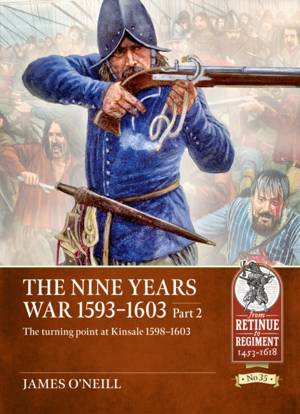
The Nine Years' War (1593-1603), sometimes known as Tyrone's Rebellion, was one of the most devastating and brutal conflicts ever to sweep the island. Never before had the English Crown come so close to losing its grip on Ireland. The war arose from a volatile combination of English misrule, Irish ambition, and the fortuitous creation of political ties with Spain. A confederation of Irish lords, led by the charismatic and exceptionally gifted Hugh O'Neill, Earl of Tyrone, swept from one victory to another. Part 2 of this series examines how the English recovered from the brink of defeat.
Hugh O'Neill's victory over the English at the Battle of the Yellow Ford ignited a fire that consumed the English plantation in Munster and significantly weakened the Crown's position in Ireland. Queen Elizabeth's favourite, the Earl of Essex, was dispatched to restore control, but his blundering leadership left Crown authority on the island close to collapse. The arrival of Charles Blount, Lord Mountjoy, at the start of 1600, however, transformed English fortunes. After seven years of near-continuous setbacks, Mountjoy turned the tide against Tyrone's confederation.
Unlike his predecessors, Mountjoy did not underestimate his enemies. He developed an island-wide strategy designed to dismantle Tyrone's network of alliances and restored order and confidence within the Crown's army by adopting many of the Irish military reforms. Supported by capable commanders such as Sir George Carew, Mountjoy rolled back Irish gains and carried the war into Tyrone's Ulster heartlands. His strategy was costly in English lives, but its success was undeniable, as relentless campaigning steadily wrested ground from Tyrone.
The fate of all sides converged with the Spanish landing of 4,000 troops at Kinsale, which led to a ferocious winter siege and the pivotal Battle of Kinsale. Mountjoy's victory on Christmas Eve 1601 shattered Tyrone's military power, but the war was not yet over. Its bloodiest phase still lay ahead, as English armies unleashed scorched-earth tactics and massacres on an unprecedented scale. Only af er Ulster was laid waste and Ireland ravaged by famine did Tyrone finally submit in 1603, bringing the war to an end and completing the Tudor conquest of Ireland.
Hugh O'Neill's victory over the English at the Battle of the Yellow Ford ignited a fire that consumed the English plantation in Munster and significantly weakened the Crown's position in Ireland. Queen Elizabeth's favourite, the Earl of Essex, was dispatched to restore control, but his blundering leadership left Crown authority on the island close to collapse. The arrival of Charles Blount, Lord Mountjoy, at the start of 1600, however, transformed English fortunes. After seven years of near-continuous setbacks, Mountjoy turned the tide against Tyrone's confederation.
Unlike his predecessors, Mountjoy did not underestimate his enemies. He developed an island-wide strategy designed to dismantle Tyrone's network of alliances and restored order and confidence within the Crown's army by adopting many of the Irish military reforms. Supported by capable commanders such as Sir George Carew, Mountjoy rolled back Irish gains and carried the war into Tyrone's Ulster heartlands. His strategy was costly in English lives, but its success was undeniable, as relentless campaigning steadily wrested ground from Tyrone.
The fate of all sides converged with the Spanish landing of 4,000 troops at Kinsale, which led to a ferocious winter siege and the pivotal Battle of Kinsale. Mountjoy's victory on Christmas Eve 1601 shattered Tyrone's military power, but the war was not yet over. Its bloodiest phase still lay ahead, as English armies unleashed scorched-earth tactics and massacres on an unprecedented scale. Only af er Ulster was laid waste and Ireland ravaged by famine did Tyrone finally submit in 1603, bringing the war to an end and completing the Tudor conquest of Ireland.
Spécifications
Parties prenantes
- Auteur(s) :
- Editeur:
Contenu
- Nombre de pages :
- 204
- Langue:
- Anglais
- Collection :
Caractéristiques
- EAN:
- 9781804517284
- Date de parution :
- 31-03-26
- Format:
- Livre broché
- Format numérique:
- Trade paperback (VS)
- Dimensions :
- 180 mm x 246 mm
- Poids :
- 498 g


Seulement chez Librairie Club
+ 83 points sur votre carte client de Librairie Club
Cadeau


Les avis
Nous publions uniquement les avis qui respectent les conditions requises. Consultez nos conditions pour les avis.