


- Retrait en 2 heures
- Assortiment impressionnant
- Paiement sécurisé
- Toujours un magasin près de chez vous
- Retrait en 2 heures
- Assortiment impressionnant
- Paiement sécurisé
- Toujours un magasin près de chez vous



45,45 €
+ 90 points
Description
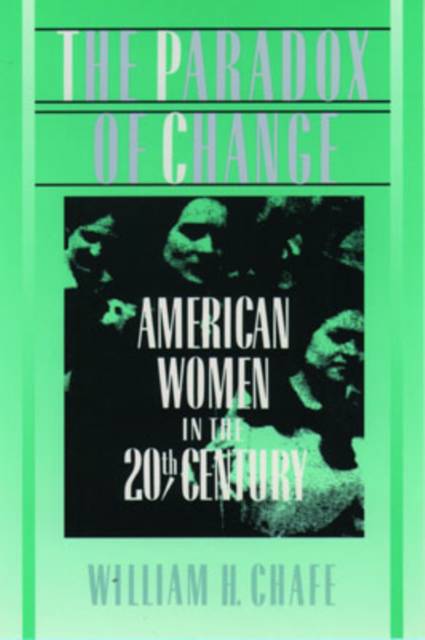
When William Chafe's The American Woman was published in 1972, it was hailed as a breakthrough in the study of women in this century. Bella Abzug praised it as "a remarkable job of historical research," and Alice Kessler-Harris called it "an extraordinarily useful synthesis of material about 20th-century women." But much has happened in the last two decades--both in terms of scholarship, and in the lives of American women. With The Paradox of Change, Chafe builds on his classic work, taking full account of the events and scholarship of the last fifteen years, as he extends his analysis into the 1990s with the rise of feminism and the New Right.
Chafe conveys all the subtleties of women's paradoxical position in the United States today, showing how women have gradually entered more fully into economic and political life, but without attaining complete social equality or economic justice. Despite the gains achieved by feminist activists during the 1970s and 1980s, the tensions continued to abound between public and private roles, and the gap separating ideals of equal opportunity from the reality of economic discrimination widened. Women may have gained some new rights in the last two decades, but the feminization of poverty has also soared, with women constituting 70% of the adult poor. Moreover, a resurgence of conservatism, symbolized by the triumph of Phyllis Schlafly's anti-ERA coalition, has cast in doubt even some of the new rights of women, such as reproductive freedom. Chafe captures these complexities and contradictions with a lively combination of representative anecdotes and archival research, all backed up by statistical studies. As in The American Woman, Chafe once again examines "woman's place" throughout the 20th century, but now with a more nuanced and inclusive approach. There are insightful portraits of the continuities of women's political activism from the Progressive era through the New Deal; of the contradictory gains and losses of the World War II years; and of the various kinds of feminism that emerged out of the tumult of the 1960s. Not least, there are narratives of all the significant struggles in which women have engaged during these last ninety years--for child care, for abortion rights, and for a chance to have both a family and a career.
The Paradox of Change is a wide-ranging history of 20th-century women, thoroughly researched and incisively argued. Anyone who wants to learn more about how women have shaped, and been shaped by, modern America will have to read this book.
Chafe conveys all the subtleties of women's paradoxical position in the United States today, showing how women have gradually entered more fully into economic and political life, but without attaining complete social equality or economic justice. Despite the gains achieved by feminist activists during the 1970s and 1980s, the tensions continued to abound between public and private roles, and the gap separating ideals of equal opportunity from the reality of economic discrimination widened. Women may have gained some new rights in the last two decades, but the feminization of poverty has also soared, with women constituting 70% of the adult poor. Moreover, a resurgence of conservatism, symbolized by the triumph of Phyllis Schlafly's anti-ERA coalition, has cast in doubt even some of the new rights of women, such as reproductive freedom. Chafe captures these complexities and contradictions with a lively combination of representative anecdotes and archival research, all backed up by statistical studies. As in The American Woman, Chafe once again examines "woman's place" throughout the 20th century, but now with a more nuanced and inclusive approach. There are insightful portraits of the continuities of women's political activism from the Progressive era through the New Deal; of the contradictory gains and losses of the World War II years; and of the various kinds of feminism that emerged out of the tumult of the 1960s. Not least, there are narratives of all the significant struggles in which women have engaged during these last ninety years--for child care, for abortion rights, and for a chance to have both a family and a career.
The Paradox of Change is a wide-ranging history of 20th-century women, thoroughly researched and incisively argued. Anyone who wants to learn more about how women have shaped, and been shaped by, modern America will have to read this book.
Spécifications
Parties prenantes
- Auteur(s) :
- Editeur:
Contenu
- Nombre de pages :
- 272
- Langue:
- Anglais
- Collection :
Caractéristiques
- EAN:
- 9780195044195
- Date de parution :
- 26-03-92
- Format:
- Livre broché
- Format numérique:
- Trade paperback (VS)
- Dimensions :
- 136 mm x 204 mm
- Poids :
- 231 g


Seulement chez Librairie Club
+ 90 points sur votre carte client de Librairie Club
Cadeau


Les avis
Nous publions uniquement les avis qui respectent les conditions requises. Consultez nos conditions pour les avis.