


- Retrait en 2 heures
- Assortiment impressionnant
- Paiement sécurisé
- Toujours un magasin près de chez vous
- Retrait en 2 heures
- Assortiment impressionnant
- Paiement sécurisé
- Toujours un magasin près de chez vous



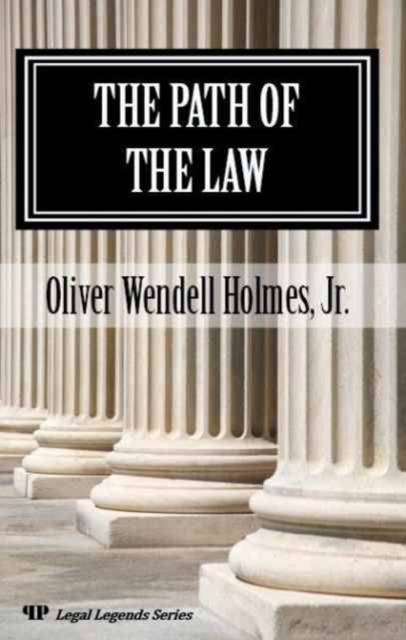
Description
The classic introduction to law and its moral import, as clearly spun for lawyers and lay thinkers alike by America's legal legend, is now available in a library-quality clothbound edition with new Foreword and in a presentation suitable for gifting and keeping; it's an excellent read the summer before law school, for social scientists and historians, and for a graduation award. This new edition adds an extensive, biographical introduction by Steven Alan Childress, J.D., M.A., Ph.D., a senior professor of law at Tulane University. Presented in the Legal Legends Series by Quid Pro Books. - Building on the pragmatic conception of law he introduced in his 1881 book 'The Common Law, ' Oliver Wendell Holmes, Jr. -- by 1897 a jurist on Massachusetts' highest court and soon to be a Justice of the U.S. Supreme Court -- explored the limits and sources of law, as well as "the forces which determine its content and growth." This presentation is seen as laying down the gauntlet to legal scholars and judges in what would be known as the emerging "legal realism" movement. Later legal thinkers like Pound, Llewellyn and Douglas followed his lead, and that lead is seen most clearly in this essay. - By the time of this pithy and accessible writing, Holmes had crystallized and clarified that conception of law which he had, in introducing his earlier book, described in the famous statement "the life of the law is not logic: it is experience." Taking that observation to the next level, this essay made it clear that judges make law, not simply finding it in books -- and they must draw on practical effects and ends in declaring legal rules, not simply reasoning from precedent. He does not hedge: it is a "fallacy" to think that "the only force at work in the development of the law is logic." - More controversially, this essay makes a powerful distinction between law and morality. Law is more about what judges do, and how people react to that, than some lofty sense of ethics, he suggests. But is his figure of the "bad man" a hero or a cautionary tale? A realistic way to look at law and social control ... or a precursor to Hitler and Stalin? It's a must-read when considering law, its social meaning, and its ultimate purposes.
Spécifications
Parties prenantes
- Auteur(s) :
- Editeur:
Contenu
- Nombre de pages :
- 58
- Langue:
- Anglais
Caractéristiques
- EAN:
- 9781610278447
- Date de parution :
- 09-02-15
- Format:
- Livre relié
- Format numérique:
- Genaaid
- Dimensions :
- 140 mm x 216 mm
- Poids :
- 199 g


Seulement chez Librairie Club
+ 41 points sur votre carte client de Librairie Club
Cadeau


Les avis
Nous publions uniquement les avis qui respectent les conditions requises. Consultez nos conditions pour les avis.