


- Retrait en 2 heures
- Assortiment impressionnant
- Paiement sécurisé
- Toujours un magasin près de chez vous
- Retrait en 2 heures
- Assortiment impressionnant
- Paiement sécurisé
- Toujours un magasin près de chez vous



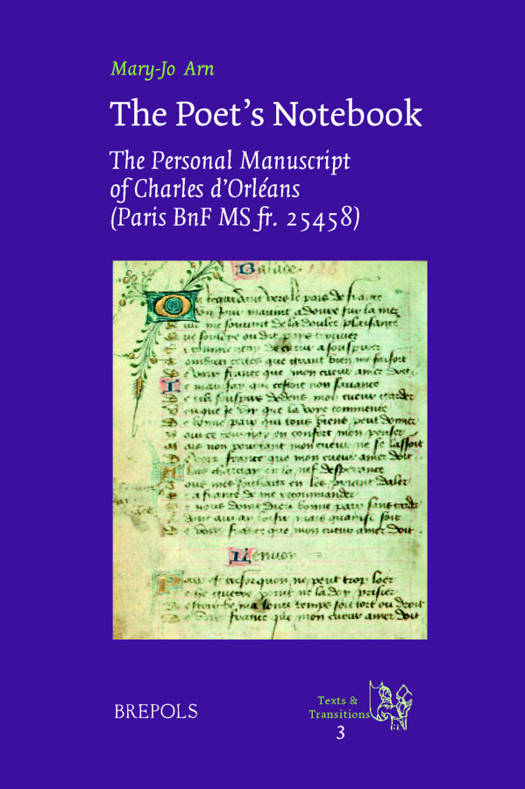
The Poet's Notebook
The Personal Manuscript of Charles d'Orléans (Paris, BnF MS fr. 25458)
Mary-Jo Arn
90,10 €
+ 180 points
Description
This study of Charles d'Orleans's personal manuscript of his poetry - the first in nearly a century - paves the way not only for a new edition of the duke's oeuvre (by Mary-Jo Arn, John Fox, and R. Barton Palmer) but for a new view of it. Following the first complete modern description of the manuscript, this study reconstructs the history of the manuscript, copying layer by copying layer. Codicological observations supplemented with palaeographical, historical, art-historical, and textual information reveal the approximate sequence of the manuscript's composition, which in turn allows a re-dating of the manuscript and some of the poems in it. Charles saw lyric form differently than did his predecessors and contemporaries, a view made manifest in the poet's own numbering of his poems. He mixed his complaintes with ballades and his rondels with chansons, each pair of forms in a numbered series, but never presenting the longer alongside the shorter forms. The analysis of the manuscript's construction corrects the current physical disorder of the later chansons and rondels, as well as that of the 'En la forest de longue actente' series (including the lyric omitted from the standard edition) and re-evaluates the handful of English poems in the manuscript. In the end, we come to understand the relationship between the visual 'messiness' of the manuscript and the poet's strong concept of lyric order. The technical aspects of the study are clarified by many tables and fascimile pages; the interactive CD contains an index of first lines that can be sorted in various ways to reveal a variety of kinds of manuscript relationships.
Spécifications
Parties prenantes
- Auteur(s) :
- Editeur:
Contenu
- Nombre de pages :
- 202
- Langue:
- Français
- Collection :
- Tome:
- n° 3
Caractéristiques
- EAN:
- 9782503520704
- Date de parution :
- 15-01-2009
- Format:
- Livre relié
- Dimensions :
- 165 mm x 244 mm
- Poids :
- 566 g


Seulement chez Librairie Club
+ 180 points sur votre carte client de Librairie Club
Cadeau


Les avis
Nous publions uniquement les avis qui respectent les conditions requises. Consultez nos conditions pour les avis.