


- Retrait en 2 heures
- Assortiment impressionnant
- Paiement sécurisé
- Toujours un magasin près de chez vous
- Retrait gratuit dans votre magasin Club
- 7.000.0000 titres dans notre catalogue
- Payer en toute sécurité
- Toujours un magasin près de chez vous



Description
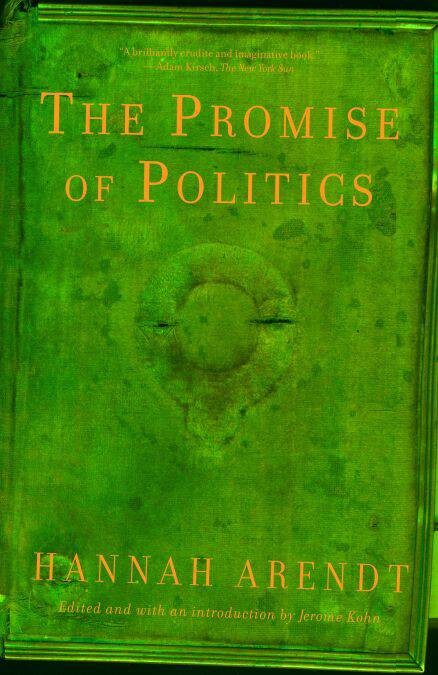
After the publication of The Origins of Totalitarianism in 1951, Hannah Arendt undertook an investigation of Marxism, a subject that she had deliberately left out of her earlier work. Her inquiry into Marx’s philosophy led her to a critical examination of the entire tradition of Western political thought, from its origins in Plato and Aristotle to its culmination and conclusion in Marx. The Promise of Politics tells how Arendt came to understand the failure of that tradition to account for human action.
From the time that Socrates was condemned to death by his fellow citizens, Arendt finds that philosophers have followed Plato in constructing political theories at the expense of political experiences, including the pre-philosophic Greek experience of beginning, the Roman experience of founding, and the Christian experience of forgiving. It is a fascinating, subtle, and original story, which bridges Arendt’s work from The Origins of Totalitarianism to The Human Condition, published in 1958. These writings, which deal with the conflict between philosophy and politics, have never before been gathered and published.
The final and longer section of The Promise of Politics, titled “Introduction into Politics,” was written in German and is published here for the first time in English. This remarkable meditation on the modern prejudice against politics asks whether politics has any meaning at all anymore. Although written in the latter half of the 1950s, what Arendt says about the relation of politics to human freedom could hardly have greater relevance for our own time. When politics is considered as a means to an end that lies outside of itself, when force is used to “create” freedom, political principles vanish from the face of the earth. For Arendt, politics has no “end”; instead, it has at times been–and perhaps can be again–the never-ending endeavor of the great plurality of human beings to live together and share the earth in mutually guaranteed freedom. That is the promise of politics.
From the time that Socrates was condemned to death by his fellow citizens, Arendt finds that philosophers have followed Plato in constructing political theories at the expense of political experiences, including the pre-philosophic Greek experience of beginning, the Roman experience of founding, and the Christian experience of forgiving. It is a fascinating, subtle, and original story, which bridges Arendt’s work from The Origins of Totalitarianism to The Human Condition, published in 1958. These writings, which deal with the conflict between philosophy and politics, have never before been gathered and published.
The final and longer section of The Promise of Politics, titled “Introduction into Politics,” was written in German and is published here for the first time in English. This remarkable meditation on the modern prejudice against politics asks whether politics has any meaning at all anymore. Although written in the latter half of the 1950s, what Arendt says about the relation of politics to human freedom could hardly have greater relevance for our own time. When politics is considered as a means to an end that lies outside of itself, when force is used to “create” freedom, political principles vanish from the face of the earth. For Arendt, politics has no “end”; instead, it has at times been–and perhaps can be again–the never-ending endeavor of the great plurality of human beings to live together and share the earth in mutually guaranteed freedom. That is the promise of politics.
Spécifications
Parties prenantes
- Auteur(s) :
- Editeur:
Contenu
- Nombre de pages :
- 256
- Langue:
- Anglais
Caractéristiques
- EAN:
- 9780307542878
- Date de parution :
- 15-01-09
- Format:
- Ebook
- Protection digitale:
- Adobe DRM
- Format numérique:
- ePub



Seulement chez Librairie Club
+ 12 points sur votre carte client de Librairie Club
Cadeau

Cadeau


Les avis
Nous publions uniquement les avis qui respectent les conditions requises. Consultez nos conditions pour les avis.