


- Retrait en 2 heures
- Assortiment impressionnant
- Paiement sécurisé
- Toujours un magasin près de chez vous
- Retrait en 2 heures
- Assortiment impressionnant
- Paiement sécurisé
- Toujours un magasin près de chez vous



5,49 €
+ 5 points
Description
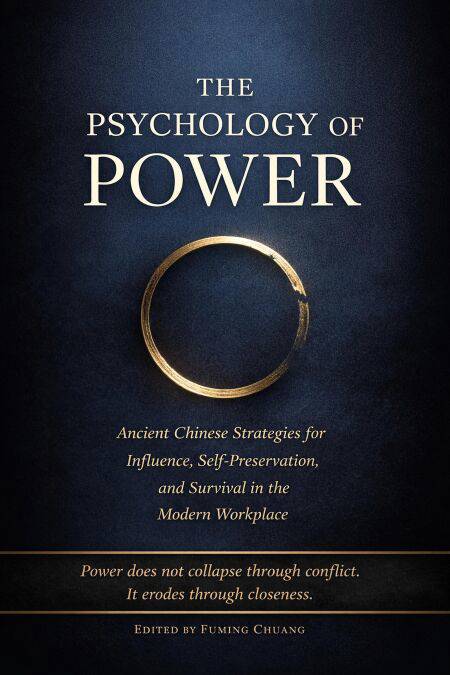
Reading the Mind of Power—ancient Chinese strategies for influence, self-preservation, and survival in the modern workplace.
Power rarely announces itself through open conflict. More often, it reshapes relationships quietly—when roles blur, when goodwill replaces structure, and when responsibility dissolves into emotion. The Psychology of Power examines how authority truly operates, not as a matter of personality or persuasion, but as a psychological and structural force that governs human behavior.
Drawing from Du Xin Shu , an ancient Chinese strategic text attributed to Tang Dynasty chancellor Li Yifu, this book offers a sober system for understanding people within hierarchies. Rather than presenting tactics for domination, it reveals how power alters perception, loyalty, resistance, and judgment—and why those who fail to recognize these shifts are often the first to be exhausted or displaced.
Across ten interconnected principles—reading, governing, seizing, deceiving, releasing, framing, opposing, capturing, guarding, and ultimately resolving the mind—the book translates classical insight into modern contexts. Its scope ranges from workplace politics and leadership dynamics to organizational conflict and personal boundary collapse. Each chapter pairs ancient logic with contemporary case studies, showing how the same psychological patterns recur across time and culture.
Placed alongside Western thinkers such as Machiavelli, Gracián, Robert Greene, Dale Carnegie, and Robert Cialdini, The Psychology of Power reveals a shared truth: while systems change, human nature does not. The pursuit of advantage, the fear of loss, and the subtle exchange between obedience and resistance follow remarkably consistent rules.
Yet this is not a manual for cold calculation. The modern value of Du Xin Shu lies in what it offers the reader today: a mirror and a form of armor. As a mirror, it clarifies the hidden mechanics behind power-driven behavior, allowing readers to observe workplaces, institutions, and relationships with greater objectivity. As armor, it teaches discernment—how to recognize framing, resist false alignment, maintain distance without hostility, and preserve oneself without cynicism.
Ultimately, the book argues that the highest wisdom is not found in technique, but in choice. The same insight can be used to exploit or to stabilize, to dominate or to protect. In an age where power is often diffuse, implicit, and psychologically taxing, The Psychology of Power serves as a guide for those who seek not to rule others, but to remain clear, intact, and self-governing within complex structures.
Spécifications
Parties prenantes
- Auteur(s) :
- Editeur:
Contenu
- Langue:
- Anglais
- Collection :
Caractéristiques
- EAN:
- 9798233356025
- Date de parution :
- 23-01-26
- Format:
- Ebook
- Protection digitale:
- /
- Format numérique:
- ePub



Seulement chez Librairie Club
+ 5 points sur votre carte client de Librairie Club
Cadeau


Les avis
Nous publions uniquement les avis qui respectent les conditions requises. Consultez nos conditions pour les avis.