


- Retrait en 2 heures
- Assortiment impressionnant
- Paiement sécurisé
- Toujours un magasin près de chez vous
- Retrait en 2 heures
- Assortiment impressionnant
- Paiement sécurisé
- Toujours un magasin près de chez vous



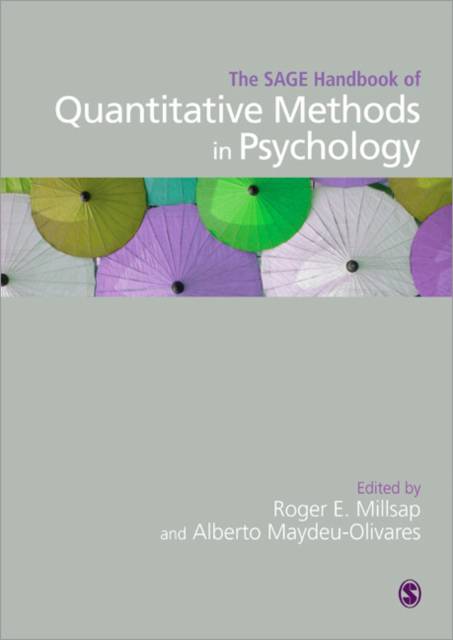
The SAGE Handbook of Quantitative Methods in Psychology
373,45 €
+ 746 points
Description
Quantitative Psychology is arguably one of the oldest disciplines within the field of psychology and nearly all psychologists are exposed to quantitative psychology in some form. While textbooks in statistics, research methods, and psychological measurement exist, none offer a unified treatment of quantitative psychology. The SAGE Handbook of Quantitative Methods in Psychology does just that. Each chapter covers a methodological topic with equal attention paid to established theory and the challenges facing methodologists as they address new research questions using that particular methodology. The reader will come away from each chapter with a greater understanding of the methodology being addressed as well as an understanding of the directions for future developments within that methodological area.
Drawing on a global scholarship the Handbook is divided into seven parts:
Part I: Measurement Theory: Begins with a chapter on classical test theory, followed by the common factor analysis model as a model for psychological measurement. The models for continuous latent variables in item response theory are covered next, followed by a chapter on discrete latent variable models as represented in latent class analysis.
Part II: Structural equation models: Addresses topics in general structural equation modeling, modeling mean structures, multiple-group models, nonlinear structural equation models, mixture models, and multilevel structural equation models.
Part III: Longitudinal models: Covers the analysis of longitudinal data via mixed modeling, repeated measures ANOVA, growth modeling, time series analysis, and event history analysis.
Part IV: Data analysis: Includes chapters on regression models, categorical data analysis, multilevel or hierarchical models, resampling methods, robust data analysis, meta-analysis, Bayesian data analysis, and cluster analysis.
Part V: Design and inference: Addresses issues in the inference of causal relations from experimental and non-experimental research, along with the design of true experiments and quasi-experiments, and the problem of missing data due to various influences such as attrition or non-compliance.
Part VI: Scaling methods: Covers metric and non-metric scaling methods as developed in multidimensional scaling, followed by consideration of the scaling of discrete measures as found in dual scaling and correspondence analysis. Models for preference data such as those found in random utility theory are covered next.
Part VII: Specialized methods: Covers specific topics including the analysis of social network data, the analysis of neuro-imaging data, and functional data analysis.
This volume is an excellent reference and resource for advanced students, academics, and professionals studying or using quantitative psychological methods in their research.
Spécifications
Parties prenantes
- Editeur:
Contenu
- Nombre de pages :
- 800
- Langue:
- Anglais
- Collection :
Caractéristiques
- EAN:
- 9781412930918
- Date de parution :
- 05-08-09
- Format:
- Livre relié
- Format numérique:
- Genaaid
- Dimensions :
- 183 mm x 246 mm
- Poids :
- 1587 g


Seulement chez Librairie Club
+ 746 points sur votre carte client de Librairie Club
Cadeau


Les avis
Nous publions uniquement les avis qui respectent les conditions requises. Consultez nos conditions pour les avis.