


En raison d'une grève chez bpost, des retards de livraison peuvent survenir. Besoin de quelque chose en urgence ? Optez pour un retrait en magasin ou rendez-vous dans une Librairie Club à proximité.
- Retrait en 2 heures
- Assortiment impressionnant
- Paiement sécurisé
- Toujours un magasin près de chez vous
En raison d'une grève chez bpost, des retards de livraison peuvent survenir. Besoin de quelque chose en urgence ? Optez pour un retrait en magasin ou rendez-vous dans une Librairie Club à proximité.
- Retrait en 2 heures
- Assortiment impressionnant
- Paiement sécurisé
- Toujours un magasin près de chez vous



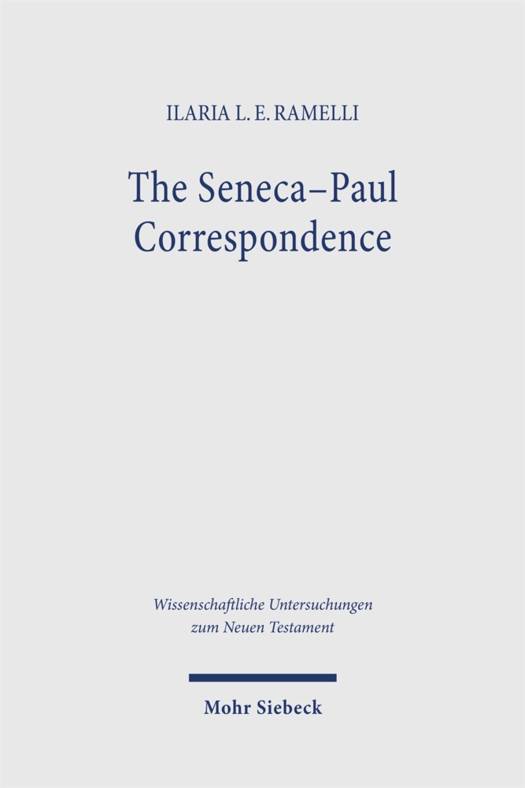
The Senecapaul Correspondence
New Research in Philology, Intertextuality, Religion and Philosophy, and the Question of Dating and Authorship
Ilaria L E Ramelli
147,45 €
+ 294 points
Description
English summary: This volume brings together the results of nearly thirty years of scholarly engagement with the pseudepigraphic Seneca-Paul correspondence. Ilaria Ramelli begins with methodological reflections on the concept of pseudepigraphy and the implications for understanding this epistolary exchange. By comparing the Seneca-Paul letters with non-literary Greek and Latin correspondence from the first to third centuries?CE, she challenges their previously assumed uniqueness and reframes them within a broader epistolary culture. The author presents Seneca and Paul first as historical figures and then as they emerge from the correspondence itself, also with attention to what Christian readers found and could appreciate in the epistolary exchange. Ramelli delves into questions of philology, intertextuality, religion and philosophy. Intertextual analysis reveals significant allusions to the New Testament - some of which, along with other clues, suggest that two letters in the extant correspondence were probably added afterwards, with different agendas. Close examination is given to syntactic Graecisms, thematic correspondences with early Christian and Stoic thought (e.g. universal culpability), and the political and theological implications of Seneca's purported reading of Pauline letters before Nero. The author critically engages with questions of dating, notably by referencing consules suffecti, and discusses the development of the legend of Seneca's "conversion" to Christianity. Furthermore, she explores the early transmission of Paul's letters, the reception of the question of Paul's education in antiquity and modern scholarship, and Seneca's complex relation to Judaism and "Paganism". Finally, Ramelli considers the relevance of Marcionite debates, the Muratorian Fragment, and Tertullian's Stoicizing Christianity. She concludes with a critical reassessment of the correspondence's value within early Christian literary, theological, and philosophical discourse. German description: Dieser Band vereint die Ergebnisse von nahezu dreissigjahriger Forschung zum pseudepigraphen Briefwechsel zwischen Seneca und Paulus. Ilaria Ramelli prasentiert zunachst methodologische Uberlegungen zum Begriff der Pseudepigraphie und dessen Bedeutung fur das Verstandnis des Briefwechsels. Durch den Vergleich der Seneca-Paulus-Briefe mit nicht-literarischen griechischen und lateinischen Briefen des 1.-3.?Jh.?n.?Chr. stellt sie deren bislang angenommene Einzigartigkeit infrage und verortet sie in einem breiteren epistolaren Kontext. Die Autorin stellt Seneca und Paulus sowohl als historische Personlichkeiten vor, als auch als literarische Figuren, wie sie aus der Korrespondenz hervorgehen. Intertextuelle Analysen offenbaren deutliche Anspielungen auf das Neue Testament - darunter Hinweise auf spatere Interpolationen von zwei Briefen. Eingehend untersucht werden syntaktische Graezismen, thematische Ubereinstimmungen mit fruhchristlichem und stoischem Denken (etwa die Universalitat von Schuld) sowie die politischen und theologischen Implikationen der uberlieferten Verlesung paulinischer Briefe durch Seneca vor Nero. Die Autorin befasst sich zudem mit Fragen der Datierung, insbesondere anhand der consules suffecti, und mit der Entstehung der Legende von Senecas "Bekehrung" zum Christentum. Daruber hinaus analysiert sie die fruhe Uberlieferung der Paulusbriefe, die Rezeption von Paulus' Bildung in Antike und moderner Forschung sowie Senecas Verhaltnis zu Judentum und Paganismus. Indem die Autorin die Sammlung der Paulusbriefe hinterfragt sowie mogliche Bezuge zum Marcionismus, zu Tertullian und zum Muratori-Fragment einbezieht, bietet sie eine Neubewertung des Briefwechsels und seiner Bedeutung innerhalb der fruhchristlichen Geistesgeschichte.
Spécifications
Parties prenantes
- Auteur(s) :
- Editeur:
Contenu
- Nombre de pages :
- 320
- Langue:
- Anglais
- Collection :
Caractéristiques
- EAN:
- 9783161646713
- Date de parution :
- 31-05-26
- Format:
- Livre relié
- Format numérique:
- Genaaid
- Dimensions :
- 155 mm x 231 mm
- Poids :
- 548 g


Seulement chez Librairie Club
+ 294 points sur votre carte client de Librairie Club
Cadeau


Les avis
Nous publions uniquement les avis qui respectent les conditions requises. Consultez nos conditions pour les avis.