


- Retrait en 2 heures
- Assortiment impressionnant
- Paiement sécurisé
- Toujours un magasin près de chez vous
- Retrait en 2 heures
- Assortiment impressionnant
- Paiement sécurisé
- Toujours un magasin près de chez vous



95,40 €
+ 190 points
Description
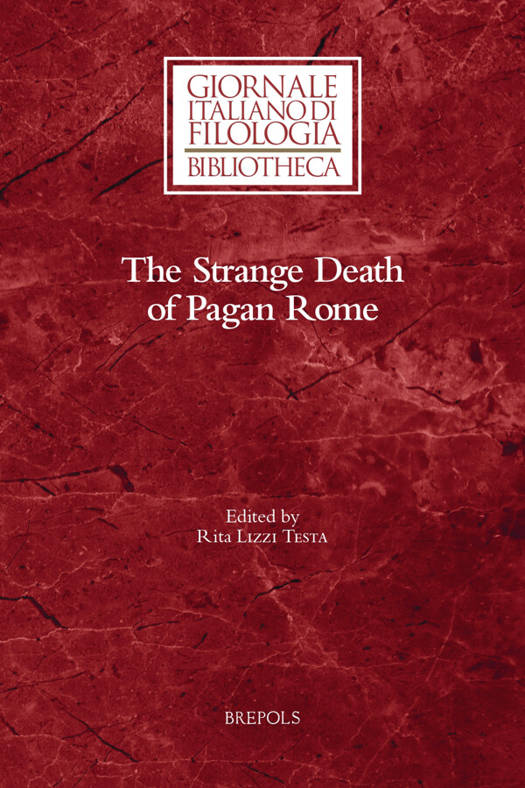
The end of paganism in antique Rome strongly involves the nature of the relations between pagans and Christians in the fourth century AD. The historical paradigm of conflict has been disseminated by scholars as the Hungarian Andras Alfoldi, who in 1934 presented a Christian Constantine in irreconcilable conflict with a pagan Rome, and by H. Bloch. The latter, most notably in 1958, in a seminar conference at the Warburg Institute, consolidated the idea of a conflictual model in which the aristocracy of Rome, faced with a tightening of measures against traditional cults, realized a real 'pagan revival' and led against Theodosius I "the last pagan army of the ancient world". This model was subjected to a massive critique by Alan Cameron in his The Last Pagans of Rome, Oxford 2011, but in the course of less than two years Cameron's publication has aroused a strong response, especially on the part of European scholars, and the debate has gained new, effervescent relevance. This volume, edited by Rita Lizzi Testa, collects the reflections of some Italian scholars - Guido Clemente, R. Lizzi Testa, Giorgio Bonamente, Silvia Orlandi, Giovanni Alberto Cecconi, Lellia Cracco Ruggini, Franca Ela Consolino, Isabella Gualandri, Gianfranco Agosti, Gianluca Grassigli, Alessandra Bravi - and of the illustrious professor Francois Paschoud from Geneva, on the theme of the last pagans of Rome. It is not only A. Alfoldi's and H. Bloch's model that provides the dialectic reference for their discussions, but rather, the more insidious in its paradoxical nature, Alan Cameron's. For the English scholar the concept of conflict is a pure historiographical construction because no real pagans remained in Rome when Theodosius issued laws against paganism. They were not pagan but classical elites, people totally soaked in classical culture, who accepted Christianity when it became compatible with classical culture and the imperial institutions. In his monumental book (more than 800 pages), he argues his position through learned demonstrations and the review of a vast amount of literary, archaeological, epigraphic and even artistic documentation. Nevertheless, much of this evidence can be read again from very different perspectives, and this is what the contributors of the volume try to do. The volume continues a collection of monographic and miscellaneous studies, now taken over by Brepols Publishers: Giornale Italiano di Filologia. BILIOTHECA (GIFBIB). This series collects studies that are intended to discuss topics on literature, exegesis and textual criticism. The publication rhythm is of one volume per year. The series is a supplement to the scholarly journal Giornale Italiano di Filologia (GIF).
Spécifications
Parties prenantes
- Auteur(s) :
- Editeur:
Contenu
- Nombre de pages :
- 198
- Langue:
- Anglais
- Collection :
- Tome:
- n° 16
Caractéristiques
- EAN:
- 9782503549422
- Date de parution :
- 24-03-14
- Format:
- Livre broché
- Format numérique:
- Trade paperback (VS)
- Dimensions :
- 152 mm x 231 mm
- Poids :
- 453 g


Seulement chez Librairie Club
+ 190 points sur votre carte client de Librairie Club
Cadeau


Les avis
Nous publions uniquement les avis qui respectent les conditions requises. Consultez nos conditions pour les avis.