


- Retrait en 2 heures
- Assortiment impressionnant
- Paiement sécurisé
- Toujours un magasin près de chez vous
- Retrait en 2 heures
- Assortiment impressionnant
- Paiement sécurisé
- Toujours un magasin près de chez vous



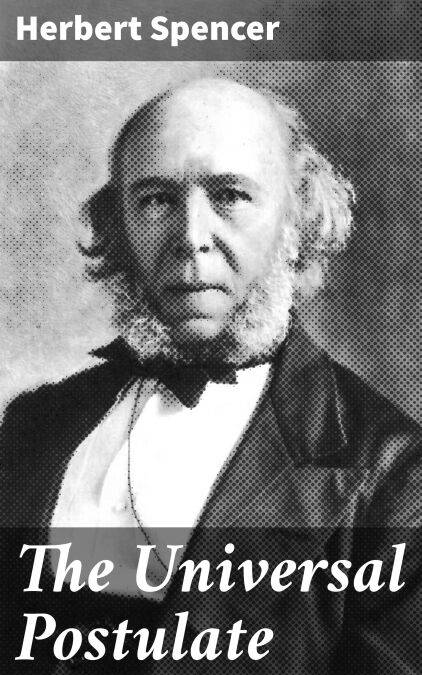
The Universal Postulate EBOOK
Exploring the Interconnected Universe through Empirical and Abstract Theories
Herbert Spencer
Ebook | Anglais
1,99 €
+ 1 points
Description
In "The Universal Postulate," Herbert Spencer presents a profound exploration of the philosophical foundations of knowledge and reality. Through a systematic analysis of logical principles, Spencer articulates his central thesis that all knowledge is rooted in a universal postulate, which encompasses fundamental truths that govern human understanding. The work is characterized by Spencer's hallmark clarity and rigor, utilizing a blend of deductive reasoning and empirical observation, placing it firmly within the intellectual currents of 19th-century scientific and philosophical discourse. This text precariously straddles the realms of philosophy, sociology, and biology, offering insights that are deeply intertwined with the emerging theories of evolution and social Darwinism of his time. Herbert Spencer, a prominent figure in the evolution of social theory, was particularly influenced by the scientific advancements of his epoch, alongside his fervent belief in progress and the survival of the fittest. His diverse body of work spans philosophy, sociology, and psychology, reflecting his fascination with the interconnectivity of societal structures and evolutionary processes. "The Universal Postulate" embodies his commitment to empiricism and rational thought, providing a compelling argument against the backdrop of Victorian intellectualism and the challenges of metaphysical inquiry. I highly recommend "The Universal Postulate" to readers interested in the intersection of philosophy and science, as well as those seeking a deeper understanding of the intellectual roots of modern social thought. Spencer's arguments invite critical reflection and provide a foundation for contemplating the nature of truth and knowledge that remains relevant today.
Spécifications
Parties prenantes
- Auteur(s) :
- Editeur:
Contenu
- Nombre de pages :
- 46
- Langue:
- Anglais
Caractéristiques
- EAN:
- 4064066430283
- Date de parution :
- 07-12-20
- Format:
- Ebook
- Protection digitale:
- Digital watermarking
- Format numérique:
- ePub


Seulement chez Librairie Club
+ 1 points sur votre carte client de Librairie Club
Cadeau


Les avis
Nous publions uniquement les avis qui respectent les conditions requises. Consultez nos conditions pour les avis.