


- Retrait en 2 heures
- Assortiment impressionnant
- Paiement sécurisé
- Toujours un magasin près de chez vous
- Retrait en 2 heures
- Assortiment impressionnant
- Paiement sécurisé
- Toujours un magasin près de chez vous



30,00 €
+ 60 points
Description
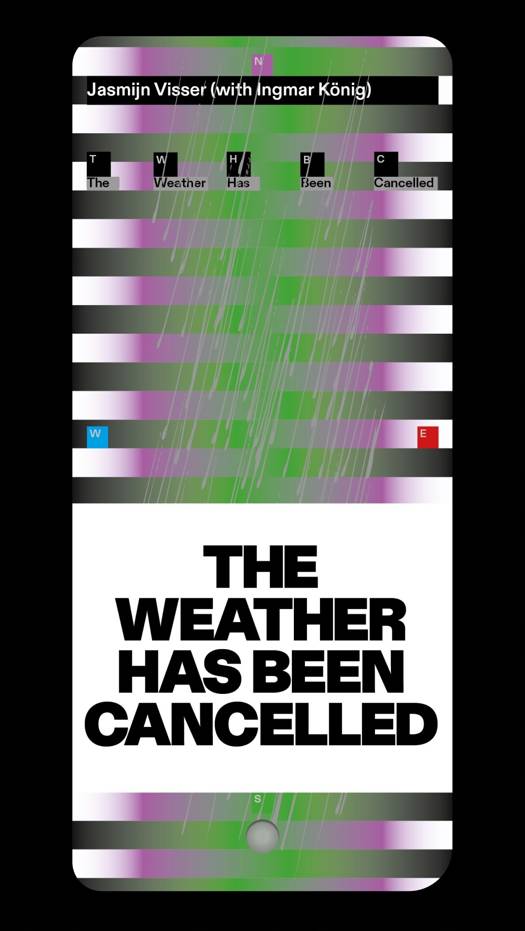
This limited edition publication is part of The weather has been cancelled (TWHBC), an artwork in the form of an interactive-fiction videogame. In the game environment, the player wakes up and discovers that the weather has been ‘cancelled’. Then the quest is revealed: The world needs you. You have to find out who cancelled the weather, and get it back! If you fail to restore the weather by midnight, all life on Earth will begin to perish. Good luck.
Subsequently, the player is left to dwell the weatherless earth.
The weather’s disappearance leaves a stunned world. Global speculation arises on who took the weather and what the possible relationship with climate change could be. Notably, now that the weather has disappeared, climate change has been ‘solved’… In a heated debate, the hard and soft sciences battle over what the weather is, different cultures question the disappearance of the weather as a mystical, supernatural event, philosophers debate the concept of nature in its Platonic form, while various countries blame geo-engineering and colonial enterprises. Meanwhile, people mourn the weather: through cultural expressions such as songs, poems, films and artworks.
How models represent climate change Decades of climate science communication have failed to affect significant socio-political change. This failing has often been assigned to the degree of abstractness of meteorological models of climate change. They build an abstract, distant world of changing averages and global thresholds. This representation merely shows a fraction of how this ecological disaster will affect the earth’s species, amongst which humans.
For instance, how will climate change alter our experience of the environment, such as the atmosphere created by the colouring of the sky, the humidity sensed on our skins, the routines we practice entangled with our climate, and the culture we created in response to it? Looking through the lens of the cultural model, our increasingly disrupted weather patterns create a sense of disorientation, an on-site displacement: the feeling of remaining in the same location while the environment drastically changes around you. This disorientation is central to TWHBC and is heightened by the act of cancelling the weather altogether: we tweak our culture closely to the local weather patterns, loosing the weather means that a large part of this culture will be lost. Hence: cancelling the weather cancels culture.
Reader The reader of The weather has been cancelled functions as an artwork in its own right. The structure resembles a colour fan, which can be read on both sides.
The first side offers the textual textual fan. Here the fixed and randomised scripts of the game can be read. The manner in which the texts offer interaction, blocking and redirection can be seen as an act of experimental fiction writing. The publication allows the reader to navigate through the locations, intertitles, clips and other textual dimensions. The fan-shape offers the reader to navigate these locations in a non-chronological manner. Just as a player in the game, the reader can jump back and forth from different locations. Aside from the name, each location is marked by a code that corresponds to the game environment map included in this booklet.
The second side is the visual fan, which forms a language in its own right. TWHBC is an environment introspective of the building blocks which are used to model environments. The visuals reference different stages of digital environment making, from the McPaint swatches to immersive blender environments to AI. In this evolution, minimal, abstract black and white environments slowly evolve to colourful worlds.
Throughout the publication the visual logic of Shortnotice Studio is interwoven. Rhythmical northern lights form a connective tissue of the booklet. As TWHBC is a world in which the weather is merely a memory, the transposed silver layer still depicts it in the form of an afterimage, forming a visual bridge between the past and present.
Biography Jasmijn Visser Complexity is always at the core of Jasmijn Visser’s practice, especially in relation to geopolitical conflict. She explores ordering, aesthetics and narrative patterns of geopolitical cases, and proposes new forms of complexity framing. Rather then reducing, abstracting or simplifying complexity, the artist seeks a way explain complexity through complexity, for example in Conflict Atlas, where she shifts the centre of the earth to the Falkland Islands to view global conflict from their perspective. Just as Visser questions the structures which build the foundation of our society, she also turns more introspective and questions what an artist is, and what the artwork can be. The artist concedes autonomy by working in multiple collaborative constructions, wether interdisciplinary or trans-disciplinary. Her artworks often are accessible online or even made by using existing structures of the internet.
Visser was part of the program of De Ateliers Amsterdam and Delfina Foundation London, and has exhibited/performed at (oa) SongEun Projectspace Seoul, Melly Rotterdam, Whitechapel Gallery London, Stedelijk Museum Amsterdam, HKW Berlin, CENART Mexico City and MOMA Moscow. She served as the artistic director of Cultural Climate Models (2019-2025) and is currently finalising her PhD at the Rachel Carson Center Munich.
The limited edition publication The weather has been cancelled (TWHBC) is part of an interactive fiction artwork. In this environment, the weather has disappeared, and the player is given the quest to reinstate it before midnight.
Rather than using the abstractness of meteorological climate models, TWHBC shows climate disruption as an ‘on-site displacement’: the feeling of remaining in the same location while the environment changes drastically around you. The publication, as an artwork in its own right, guides you through the writing of this cultural model. The book’s structure resembles a colour fan, which offers non-linear navigation through the text.
Subsequently, the player is left to dwell the weatherless earth.
The weather’s disappearance leaves a stunned world. Global speculation arises on who took the weather and what the possible relationship with climate change could be. Notably, now that the weather has disappeared, climate change has been ‘solved’… In a heated debate, the hard and soft sciences battle over what the weather is, different cultures question the disappearance of the weather as a mystical, supernatural event, philosophers debate the concept of nature in its Platonic form, while various countries blame geo-engineering and colonial enterprises. Meanwhile, people mourn the weather: through cultural expressions such as songs, poems, films and artworks.
How models represent climate change Decades of climate science communication have failed to affect significant socio-political change. This failing has often been assigned to the degree of abstractness of meteorological models of climate change. They build an abstract, distant world of changing averages and global thresholds. This representation merely shows a fraction of how this ecological disaster will affect the earth’s species, amongst which humans.
For instance, how will climate change alter our experience of the environment, such as the atmosphere created by the colouring of the sky, the humidity sensed on our skins, the routines we practice entangled with our climate, and the culture we created in response to it? Looking through the lens of the cultural model, our increasingly disrupted weather patterns create a sense of disorientation, an on-site displacement: the feeling of remaining in the same location while the environment drastically changes around you. This disorientation is central to TWHBC and is heightened by the act of cancelling the weather altogether: we tweak our culture closely to the local weather patterns, loosing the weather means that a large part of this culture will be lost. Hence: cancelling the weather cancels culture.
Reader The reader of The weather has been cancelled functions as an artwork in its own right. The structure resembles a colour fan, which can be read on both sides.
The first side offers the textual textual fan. Here the fixed and randomised scripts of the game can be read. The manner in which the texts offer interaction, blocking and redirection can be seen as an act of experimental fiction writing. The publication allows the reader to navigate through the locations, intertitles, clips and other textual dimensions. The fan-shape offers the reader to navigate these locations in a non-chronological manner. Just as a player in the game, the reader can jump back and forth from different locations. Aside from the name, each location is marked by a code that corresponds to the game environment map included in this booklet.
The second side is the visual fan, which forms a language in its own right. TWHBC is an environment introspective of the building blocks which are used to model environments. The visuals reference different stages of digital environment making, from the McPaint swatches to immersive blender environments to AI. In this evolution, minimal, abstract black and white environments slowly evolve to colourful worlds.
Throughout the publication the visual logic of Shortnotice Studio is interwoven. Rhythmical northern lights form a connective tissue of the booklet. As TWHBC is a world in which the weather is merely a memory, the transposed silver layer still depicts it in the form of an afterimage, forming a visual bridge between the past and present.
Biography Jasmijn Visser Complexity is always at the core of Jasmijn Visser’s practice, especially in relation to geopolitical conflict. She explores ordering, aesthetics and narrative patterns of geopolitical cases, and proposes new forms of complexity framing. Rather then reducing, abstracting or simplifying complexity, the artist seeks a way explain complexity through complexity, for example in Conflict Atlas, where she shifts the centre of the earth to the Falkland Islands to view global conflict from their perspective. Just as Visser questions the structures which build the foundation of our society, she also turns more introspective and questions what an artist is, and what the artwork can be. The artist concedes autonomy by working in multiple collaborative constructions, wether interdisciplinary or trans-disciplinary. Her artworks often are accessible online or even made by using existing structures of the internet.
Visser was part of the program of De Ateliers Amsterdam and Delfina Foundation London, and has exhibited/performed at (oa) SongEun Projectspace Seoul, Melly Rotterdam, Whitechapel Gallery London, Stedelijk Museum Amsterdam, HKW Berlin, CENART Mexico City and MOMA Moscow. She served as the artistic director of Cultural Climate Models (2019-2025) and is currently finalising her PhD at the Rachel Carson Center Munich.
The limited edition publication The weather has been cancelled (TWHBC) is part of an interactive fiction artwork. In this environment, the weather has disappeared, and the player is given the quest to reinstate it before midnight.
Rather than using the abstractness of meteorological climate models, TWHBC shows climate disruption as an ‘on-site displacement’: the feeling of remaining in the same location while the environment changes drastically around you. The publication, as an artwork in its own right, guides you through the writing of this cultural model. The book’s structure resembles a colour fan, which offers non-linear navigation through the text.
Spécifications
Parties prenantes
- Auteur(s) :
- Editeur:
Contenu
- Langue:
- Anglais
Caractéristiques
- EAN:
- 9789493329775
- Date de parution :
- 20-03-26
- Format:
- Livre broché
- Dimensions :
- 83 mm x 184 mm
- Poids :
- 549 g


Seulement chez Librairie Club
+ 60 points sur votre carte client de Librairie Club
Cadeau


Les avis
Nous publions uniquement les avis qui respectent les conditions requises. Consultez nos conditions pour les avis.