


- Retrait en 2 heures
- Assortiment impressionnant
- Paiement sécurisé
- Toujours un magasin près de chez vous
- Retrait en 2 heures
- Assortiment impressionnant
- Paiement sécurisé
- Toujours un magasin près de chez vous



33,95 €
+ 67 points
Format
Description
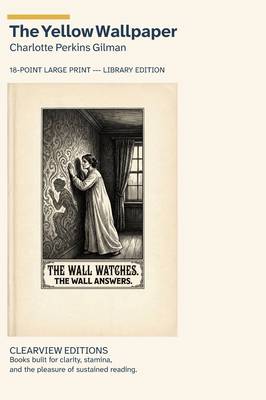
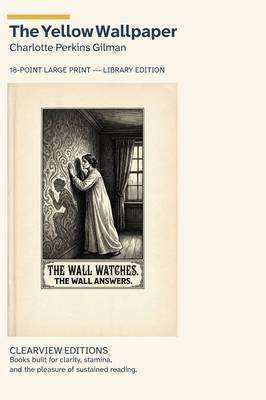
The Yellow Wallpaper by Charlotte Perkins Gilman, originally published 1892. The Yellow Wallpaper was published in 1892 by an American writer and lecturer who had herself been prescribed the so-called rest cure by Dr. Silas Weir Mitchell and discovered, the hard way, that it was driving her mad. Gilman wrote the case history her doctor refused to read and made it the founding short story of feminist American literature. The story still matters because it is the cleanest first-person account in English of a medical establishment refusing to believe a woman about her own mind. This Clearview Editions hardcover is built on a production standard that significantly exceeds the industry norm for large-print publishing. The body text is set at 18-point Atkinson Hyperlegible Next on 24-point leading, a 1.33-ratio line-spacing pairing that meets American Printing House for the Blind and NAVH standards for "super large print." The leading North American large-print hardcover imprints typically set their body text at 16 point, and most large-print trade paperbacks release at 14 to 16 point. At 18 point, Clearview Editions offers text that is measurably larger than every other major large-print publisher, specifically for readers with low vision, macular degeneration, glaucoma, diabetic retinopathy, or any visual condition that makes standard trade print frustrating or impossible to read for long stretches. The trim size is equally generous. Clearview Editions is printed on a 7x10-inch page, substantially larger than the 6x9 hardcover that is standard in the large-print industry and roughly 50 percent larger by area than the 5x8 trade paperback trim most legacy large-print paperback imprints use. The extra page area is deliberate: it allows the 18-point body to set at the 50-to-55 character line length that reading-fatigue research identifies as optimal, without the narrow text columns and cramped margins that plague smaller-trim large-print books. Wide interior margins keep the binding from swallowing the gutter text and leave the thumb margins comfortable for older hands gripping a heavier hardcover. The body font, Atkinson Hyperlegible Next, was developed by the Braille Institute of America specifically to maximize letter recognition for readers with low vision, macular degeneration, and visual processing differences. It distinguishes between commonly-confused letter pairs - lowercase l versus uppercase I, the digit 0 versus uppercase O, b versus d, p versus q - using distinctive shape features that preserve readability even under eye strain. Text is justified with careful hyphenation tuning for a clean right margin without the distracting interword gaps of cheap large-print reprints, every page is protected against widowed and orphaned lines, and all illustrations are reproduced in 300-DPI grayscale on coated white text stock. The text of this edition is faithfully preserved from the original public-domain source with the full structural integrity of parts and chapters as the author intended, and a dedicated "Begin Reading" bookmark anchors the first chapter for readers using digital reading devices or reading software. Clearview Editions is an imprint of Nimble Books LLC, dedicated to bringing the canon of public-domain literature to low-vision readers and to anyone who has ever found standard trade-paperback print too small, too cramped, or too tiring for the kind of sustained reading a great book deserves. Clarity before ornament.
Spécifications
Parties prenantes
- Auteur(s) :
- Editeur:
Contenu
- Nombre de pages :
- 36
- Langue:
- Anglais
- Collection :
Caractéristiques
- EAN:
- 9781608888245
- Date de parution :
- 26-09-26
- Format:
- Livre relié
- Format numérique:
- Genaaid
- Dimensions :
- 178 mm x 254 mm
- Poids :
- 290 g


Seulement chez Librairie Club
+ 67 points sur votre carte client de Librairie Club
Cadeau


Les avis
Nous publions uniquement les avis qui respectent les conditions requises. Consultez nos conditions pour les avis.