


- Retrait en 2 heures
- Assortiment impressionnant
- Paiement sécurisé
- Toujours un magasin près de chez vous
- Retrait en 2 heures
- Assortiment impressionnant
- Paiement sécurisé
- Toujours un magasin près de chez vous



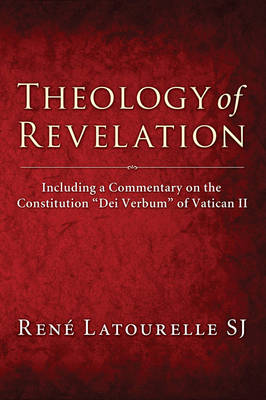
Theology of Revelation
Including a Commentary on the Constitution "Dei Verbum" of Vatican II
René Latourelle
Livre broché | Anglais
104,45 €
+ 208 points
Description
For fruitful discussion within the Church, for a meaningful dialogue with other Christians, for the renewal of the theology of preaching--for these and many other reasons, we need a new understanding of the nature of revelation. The usual apologetical treatment of revelation, bent on proving its existence, touches but the fringe of the reality. Our day and age needs a theology of revelation which probes the nature, depths and dimensions of the mystery. Father Latourelle's study is a significant contribution in this unfurrowed field, and may well be recognized as a landmark for years to come. His treatment of scriptural data on the notion of revelation is grounded on the advances of twentieth century exegesis. He admirably handles the multifaceted Old Testament notion of revelation; and his detailed study of the Synoptics, Acts, Paul, and John heightens the point that the Old Testament's revelation foreshadowed the New, and the New is only intelligible against the background of the Old. His summary of the patristic idea of revelation is erudite and stimulating, and probes the thoughts of twenty writers from the Apostolic Fathers to Augustine. The richness of patristic insight contrasts sharply with later theological studies of the nature of revelation. His study of the theological thought of the scholastic and neo-scholastic schools is critical and informative. Their approach culminated in overstressing the apologetical aspects of revelation--a course which modern theology is abandoning to re-discover a theology of revelation that is Christ-centered, Scriptural, historical and interpersonal. In treating of the magisterium, the author presents a splendid analysis of official documents from Trent to Vatican II, and his summary underscores the point that the Church documents present a view of revelation that closely resembles that of the biblical and patristic sources. The author's personal reflections enable us to view many aspects of revelation in a new light. He draws on the insights of modern linguistics to give a new dimension to revelation's traditional definition, locutio Dei. He elucidates the point that revelation is neither event alone nor word alone--its structure is sacramental and consists of events interpreted by word . . . In dealing with preaching, miracles and other themes, Father Latourelle combines wide erudition and lucidity, and his work stands as a major contribution to modern theological thought.
Spécifications
Parties prenantes
- Auteur(s) :
- Editeur:
Contenu
- Nombre de pages :
- 520
- Langue:
- Anglais
Caractéristiques
- EAN:
- 9781608991426
- Date de parution :
- 01-11-09
- Format:
- Livre broché
- Format numérique:
- Trade paperback (VS)
- Dimensions :
- 170 mm x 239 mm
- Poids :
- 839 g


Seulement chez Librairie Club
+ 208 points sur votre carte client de Librairie Club
Cadeau


Les avis
Nous publions uniquement les avis qui respectent les conditions requises. Consultez nos conditions pour les avis.