


- Retrait en 2 heures
- Assortiment impressionnant
- Paiement sécurisé
- Toujours un magasin près de chez vous
- Retrait en 2 heures
- Assortiment impressionnant
- Paiement sécurisé
- Toujours un magasin près de chez vous



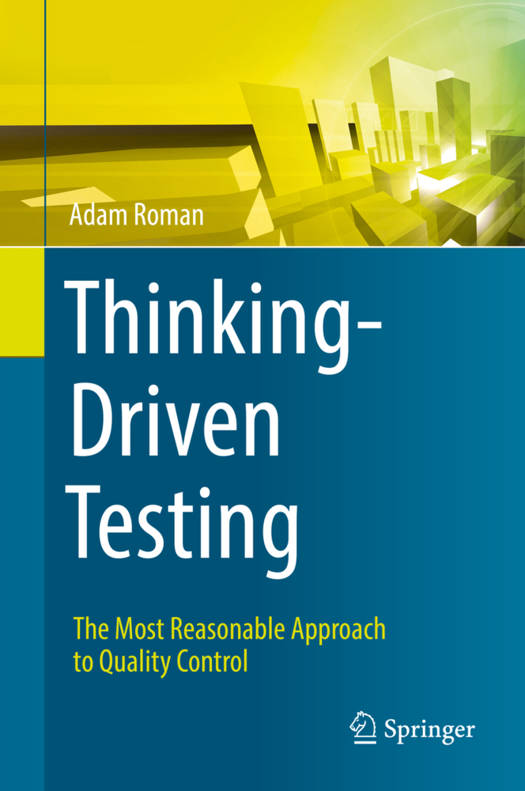
Thinking-Driven Testing
The Most Reasonable Approach to Quality Control
Adam Roman
Livre relié | Anglais
75,95 €
+ 151 points
Format
Description
This book presents a new paradigm of software testing by emphasizing the role of critical thinking, system thinking and rationality as the most important skills for the tester. It thus approaches software testing from a different perspective than in past literature, as the vast majority of books describe testing in the context of specific tools, automation, documentation, particular test design techniques or test management. In addition, the book proposes a novel meta-approach for designing effective test strategies, which is based on recent advances in psychology, economics, system sciences and logic.
Chapter 1 starts by introducing the fundamental ideas underlying software testing. Chapter 2 then describes meta-strategies in software testing, i.e. general approaches that can be adapted to many different situations that a software tester encounters. Next, Chapter 3 presents the concept of Thinking-Driven Testing (TDT). This approach utilizes the concepts discussed in the two previous chapters and introduces the main ideas that underlie a reasonable and optimal approach to software testing. Chapter 4 builds on this basis and proposes a specific approach to testing, called TQED, that makes it possible to increase creativity in the context of delivering effective, optimal test ideas. Chapter 5 provides an overview of different types of testing techniques in order to understand the fundamental concepts of test design, while Chapter 6 details various pitfalls a tester may encounter and that can originate from a wide range of testing process areas. Lastly, Chapter 7 puts all this into practice, as it contains several exercises that will help testers develop a number of crucial skills: logical thinking and reasoning, thinking out of the box, creativity, counting and estimating, and analytical thinking.
By promoting critical, rational and creative thinking, this book invites readers to re-examine common assumptions regarding software testing and shows them how to become professional testers who bring added value to their company.
Chapter 1 starts by introducing the fundamental ideas underlying software testing. Chapter 2 then describes meta-strategies in software testing, i.e. general approaches that can be adapted to many different situations that a software tester encounters. Next, Chapter 3 presents the concept of Thinking-Driven Testing (TDT). This approach utilizes the concepts discussed in the two previous chapters and introduces the main ideas that underlie a reasonable and optimal approach to software testing. Chapter 4 builds on this basis and proposes a specific approach to testing, called TQED, that makes it possible to increase creativity in the context of delivering effective, optimal test ideas. Chapter 5 provides an overview of different types of testing techniques in order to understand the fundamental concepts of test design, while Chapter 6 details various pitfalls a tester may encounter and that can originate from a wide range of testing process areas. Lastly, Chapter 7 puts all this into practice, as it contains several exercises that will help testers develop a number of crucial skills: logical thinking and reasoning, thinking out of the box, creativity, counting and estimating, and analytical thinking.
By promoting critical, rational and creative thinking, this book invites readers to re-examine common assumptions regarding software testing and shows them how to become professional testers who bring added value to their company.
Spécifications
Parties prenantes
- Auteur(s) :
- Editeur:
Contenu
- Nombre de pages :
- 305
- Langue:
- Anglais
Caractéristiques
- EAN:
- 9783319731940
- Date de parution :
- 27-03-18
- Format:
- Livre relié
- Format numérique:
- Genaaid
- Dimensions :
- 156 mm x 234 mm
- Poids :
- 639 g


Seulement chez Librairie Club
+ 151 points sur votre carte client de Librairie Club
Cadeau


Les avis
Nous publions uniquement les avis qui respectent les conditions requises. Consultez nos conditions pour les avis.