


- Retrait en 2 heures
- Assortiment impressionnant
- Paiement sécurisé
- Toujours un magasin près de chez vous
- Retrait en 2 heures
- Assortiment impressionnant
- Paiement sécurisé
- Toujours un magasin près de chez vous



23,95 €
+ 47 points
Description
"History offers no example where so much was accomplished in so short a time, or where so many events were crowded into the space of four years, in which the Navy was employed subduing a coast over four thousand miles in length, and recapturing a river-coast of more than five thousand miles," wrote Rear Admiral David Dixon Porter in his 1886 The Naval History of the Civil War.
Porter's words demonstrate the true scale of the war's naval activity. Thousands of ships took part, fighting battles alongside the armies and patrolling the globe. The actions of more than 100,000 sailors on both sides impacted military, naval, economic, and diplomatic aspects, all while providing the tools to realize the Anaconda Plan of isolating and splitting the Confederacy.
Unlike the army dividing its efforts into the Eastern, Western, and Trans-Mississippi theaters, the Civil War's naval forces fought in four distinct theaters of conflict. The offshore blockade was an economic and logistical campaign waged to determine whether Southern armies would remain properly supplied. Sailors enacting that blockade worked in tandem with armies to assault cities and coastal areas to deny the Confederacy its ports and coastal infrastructure, while Confederate sailors fought to both break the blockade and keep control of its ports. Meanwhile, fleets on both sides battled for control over the Mississippi River Valley in an effort to cleave off the Trans-Mississippi Theater from the rest of the Confederacy. Finally, an economic and diplomatic war was waged across the oceans, where Southern privateers and commerce raiders prowled for Federal merchant ships.
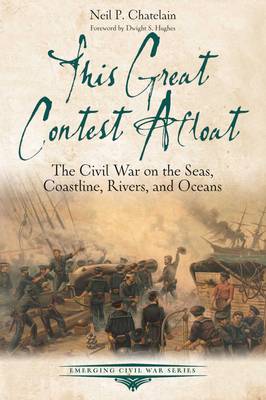
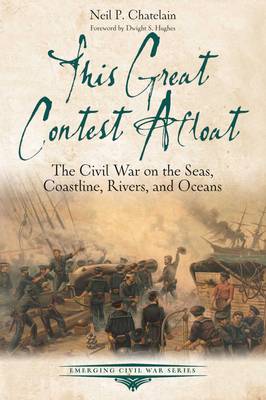
In This Great Contest Afloat: The Civil War on the Seas, Coastline, Rivers, and Oceans, award-winning historian and professor Neil P. Chatelain unpacks each of these naval theaters. Using prolific firsthand accounts merged with keen macro analysis, Chatelain invites readers to board blockade-runners, tread the beaches during coastal assaults, ride on riverine ironclads, and sail on targeted merchant vessels, all the while demonstrating the extent and impact of Civil War naval activity.
Porter's words demonstrate the true scale of the war's naval activity. Thousands of ships took part, fighting battles alongside the armies and patrolling the globe. The actions of more than 100,000 sailors on both sides impacted military, naval, economic, and diplomatic aspects, all while providing the tools to realize the Anaconda Plan of isolating and splitting the Confederacy.
Unlike the army dividing its efforts into the Eastern, Western, and Trans-Mississippi theaters, the Civil War's naval forces fought in four distinct theaters of conflict. The offshore blockade was an economic and logistical campaign waged to determine whether Southern armies would remain properly supplied. Sailors enacting that blockade worked in tandem with armies to assault cities and coastal areas to deny the Confederacy its ports and coastal infrastructure, while Confederate sailors fought to both break the blockade and keep control of its ports. Meanwhile, fleets on both sides battled for control over the Mississippi River Valley in an effort to cleave off the Trans-Mississippi Theater from the rest of the Confederacy. Finally, an economic and diplomatic war was waged across the oceans, where Southern privateers and commerce raiders prowled for Federal merchant ships.
In This Great Contest Afloat: The Civil War on the Seas, Coastline, Rivers, and Oceans, award-winning historian and professor Neil P. Chatelain unpacks each of these naval theaters. Using prolific firsthand accounts merged with keen macro analysis, Chatelain invites readers to board blockade-runners, tread the beaches during coastal assaults, ride on riverine ironclads, and sail on targeted merchant vessels, all the while demonstrating the extent and impact of Civil War naval activity.
Spécifications
Parties prenantes
- Auteur(s) :
- Editeur:
Contenu
- Nombre de pages :
- 192
- Langue:
- Anglais
- Collection :
Caractéristiques
- EAN:
- 9781611217773
- Date de parution :
- 15-04-26
- Format:
- Livre broché
- Format numérique:
- Trade paperback (VS)
- Dimensions :
- 152 mm x 229 mm
- Poids :
- 294 g


Seulement chez Librairie Club
+ 47 points sur votre carte client de Librairie Club
Cadeau


Les avis
Nous publions uniquement les avis qui respectent les conditions requises. Consultez nos conditions pour les avis.