


- Retrait en 2 heures
- Assortiment impressionnant
- Paiement sécurisé
- Toujours un magasin près de chez vous
- Retrait en 2 heures
- Assortiment impressionnant
- Paiement sécurisé
- Toujours un magasin près de chez vous




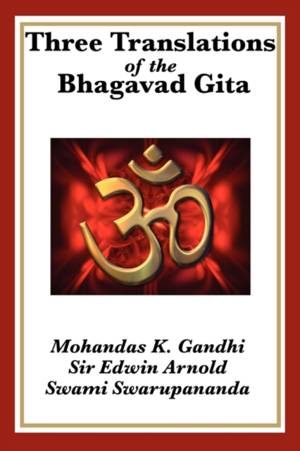
Three Translations of the Bhagavad Gita
Classic Renderings of a Foundational Text of Eastern Spiritual Philosophy
Mohandas K Gandhi, Sir Edwin Arnold, Swami Swarupananda
Livre broché | Anglais
24,45 €
+ 48 points
Format
Description
This omnibus edition presents three influential translations of the sacred Hindu scripture Bhagavad Gita, offering complementary perspectives on one of the foundational works of Eastern spiritual philosophy.
Collected in this volume are translations by Swami Swarupananda, Mahatma Gandhi, and Edwin Arnold. Considered together, these interpretations illuminate the depth and subtlety of the Gita's teachings, allowing readers to encounter the text through differing philosophical and devotional traditions.
The Bhagavad Gita appears as a celebrated episode within the great Sanskrit epic the Mahabharata, occurring in the sixth book, traditionally known as the Bhishma Parva. Framed as a dialogue between Prince Arjuna and the divine teacher Krishna on the eve of battle, the work addresses enduring questions of duty, action, spiritual knowledge, and liberation. Over many centuries it has become one of the most widely read and revered texts of Indian philosophy.
The philosophical vision of the Gita reflects the convergence of several strands of Indian thought, including the metaphysical insights of the Vedas, the analytical philosophy associated with Kapila, and the disciplined spiritual practice later systematised by Patanjali. For readers across the world, the text remains one of the clearest and most powerful expressions of the spiritual traditions of Asia.
Reflecting on his own engagement with the work, Mahatma Gandhi described the Gita as a constant spiritual companion. First encountering Sir Edwin Arnold's poetic rendering The Song Celestial, Gandhi later studied the text in several languages before presenting his own interpretation. For him the Gita was not merely a work of study but a guide to ethical conduct and spiritual discipline in daily life.
Spécifications
Parties prenantes
- Auteur(s) :
- Traducteur(s):
- Editeur:
Contenu
- Nombre de pages :
- 224
- Langue:
- Anglais
Caractéristiques
- EAN:
- 9781617203398
- Date de parution :
- 24-04-11
- Format:
- Livre broché
- Format numérique:
- Trade paperback (VS)
- Dimensions :
- 152 mm x 229 mm
- Poids :
- 335 g


Seulement chez Librairie Club
+ 48 points sur votre carte client de Librairie Club
Cadeau


Les avis
Nous publions uniquement les avis qui respectent les conditions requises. Consultez nos conditions pour les avis.