


- Retrait en 2 heures
- Assortiment impressionnant
- Paiement sécurisé
- Toujours un magasin près de chez vous
- Retrait gratuit dans votre magasin Club
- 7.000.0000 titres dans notre catalogue
- Payer en toute sécurité
- Toujours un magasin près de chez vous



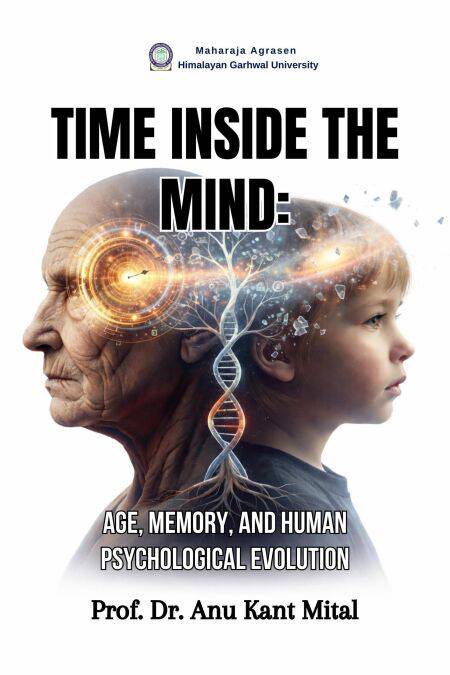
Time Inside the Mind: Age, Memory, and Human Psychological Evolution EBOOK
Prof. Dr. Anu Kant Mital
Ebook | Anglais
2,99 €
+ 2 points
Description
Time is one of the most familiar yet mysterious elements of human existence. We measure it precisely with clocks and calendars, yet we experience it subjectively-sometimes flowing effortlessly, sometimes stretching unbearably, and at other moments slipping away before we realize it has passed. This book, Time Inside the Mind: Age, Memory, and Human Psychological Evolution, is born from the recognition that time is not merely an external dimension, but a deeply psychological phenomenon shaped by memory, emotion, development, culture, and biology.
The central aim of this book is to explore how human beings experience time across the lifespan. From the earliest moments of childhood, when the present dominates awareness, to later life, where reflection and reminiscence give time its depth and meaning, our relationship with time continually evolves. Memory acts as the thread that binds these stages together, allowing the past to inform the present and the future to be imagined. Understanding this dynamic relationship between time and memory offers valuable insight into human identity, decision-making, emotional regulation, and psychological well-being.
This book takes an interdisciplinary approach, drawing upon cognitive psychology, developmental science, neuroscience, sociology, and evolutionary perspectives. Rather than treating time as a fixed entity, the chapters examine how subjective time is shaped by cognitive growth, emotional intensity, routine, aging, cultural norms, and technological change. Special attention is given to how modern life-characterized by speed, digital memory, and extended longevity-is reshaping our temporal consciousness in unprecedented ways.
The content is structured to move progressively through the human lifespan, while also situating individual experience within broader biological and cultural frameworks. Each chapter is designed to be conceptually clear and empirically grounded, making the book suitable for undergraduate and postgraduate students, researchers, educators, and readers with a general interest in psychology and human behaviour. Real-world examples and contemporary research are used to bridge theory and lived experience.
This book is an invitation to examine the machinery behind that travel. It explores the tension between Kronos (quantitative, linear time) and Kairos (the qualitative, opportune moment). By bridging these concepts, we reveal why a childhood summer felt like an eternity, while a year in middle age vanishes in a blink.
The methodology behind this volume is rooted in the "Tripartite Model of Temporal Experience": the biological clock, the cognitive processor, and the social construct. We delve into the neurochemical messengers, like dopamine, that speed up our internal metronome during moments of excitement, and the inhibitory processes that slow it down during boredom or trauma. Furthermore, we address the "scarcity mindset"—the psychological state of feeling that time is a vanishing resource—and how this impacts our decision-making, from financial investments to romantic commitments.
Ultimately, Time Inside the Mind invites readers to reflect on their own relationship with time. By understanding how the mind constructs and interprets temporal experience, we gain the ability not only to study human psychological evolution but also to live more consciously within the time we have. This book hopes to encourage thoughtful engagement with the rhythms of memory, aging, and change that define the human journey.
Spécifications
Parties prenantes
- Auteur(s) :
- Editeur:
Contenu
- Langue:
- Anglais
Caractéristiques
- EAN:
- 9789375590163
- Date de parution :
- 02-02-26
- Format:
- Ebook
- Protection digitale:
- /
- Format numérique:
- ePub


Seulement chez Librairie Club
+ 2 points sur votre carte client de Librairie Club
Cadeau

Cadeau


Les avis
Nous publions uniquement les avis qui respectent les conditions requises. Consultez nos conditions pour les avis.