


- Retrait en 2 heures
- Assortiment impressionnant
- Paiement sécurisé
- Toujours un magasin près de chez vous
- Retrait en 2 heures
- Assortiment impressionnant
- Paiement sécurisé
- Toujours un magasin près de chez vous



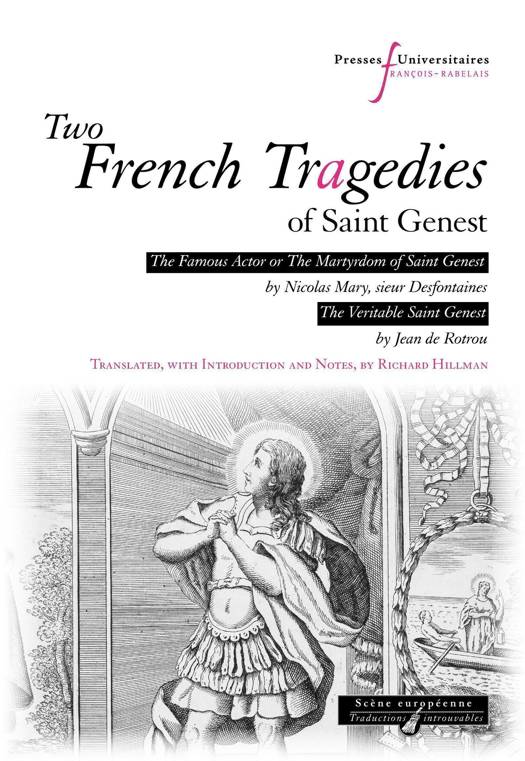
Two French Tragedies of Saint Genest:
Pièces de dévotion (Hagiographic Plays) The Famous Actor or The Martyrdom of Saint Genest, by Nicolas Mary, sieur Desfontaines; The Veritable Saint Genest, by Jean de Rotrou Translated, with Introduction and Notes, by Richard Hillman
Richard Hillman
Livre | Anglais
24,00 €
+ 48 points
Description
As the Introduction demonstrates, these two dramatisatioins of the legend of Saint Genest (Lat. Genesius) are richly complementary as dramatic texts, precisely by virtue of their contrasting approaches. They are also revealing with regard to a significant, but often neglected, strain of mid-seventeenth century French tragedy.
That the plays were virtually contemporary—both created in or around the same year (1644)—bears witness to the attraction of their common subject. The legend of the actor-saint and martyr, which Lope de Vega had previously dramatised in Lo fingido verdadera (pub. 1620), was taking on increased importance in the context of a defence on the Parisian dramatic scene of théâtre dévot and theatre generally.
The relation between the two French plays, which were produced by rival troupes (at the Hôtel de Bourgogne and L'Illustre Théâtre), raises provocative—and productive—questions, beginning with their uncertain chronological order. That Rotrou was responding to the work of Desfontaines may (or may not) be reflected in the claim in his title to be presenting the “veritable” (“véritable”) Saint Genest. In any case, his play more thoroughly exploits the metadramatic potential inherent in the legend, according to which Genest was converted by divine intervention during a performance. The episode is developed by Rotrou so as to comment profoundly, from a Christian point of view, on the relation between true and false identities. The venerable notion of theatrum mundi is deployed with subtle yet forceful irony.
Yet while Desfontaines's treatment is more straightforward, it is by no means without powerful dramatic moments, linked especially with the romantic relation between Genest and the actress Pamphilie. For their terrestrial love evolves, by a further act of conversion, into a shared spiritual commitment and double martyrdom that shake the confidence, even the pagan faith, of their Roman persecutor.
That the plays were virtually contemporary—both created in or around the same year (1644)—bears witness to the attraction of their common subject. The legend of the actor-saint and martyr, which Lope de Vega had previously dramatised in Lo fingido verdadera (pub. 1620), was taking on increased importance in the context of a defence on the Parisian dramatic scene of théâtre dévot and theatre generally.
The relation between the two French plays, which were produced by rival troupes (at the Hôtel de Bourgogne and L'Illustre Théâtre), raises provocative—and productive—questions, beginning with their uncertain chronological order. That Rotrou was responding to the work of Desfontaines may (or may not) be reflected in the claim in his title to be presenting the “veritable” (“véritable”) Saint Genest. In any case, his play more thoroughly exploits the metadramatic potential inherent in the legend, according to which Genest was converted by divine intervention during a performance. The episode is developed by Rotrou so as to comment profoundly, from a Christian point of view, on the relation between true and false identities. The venerable notion of theatrum mundi is deployed with subtle yet forceful irony.
Yet while Desfontaines's treatment is more straightforward, it is by no means without powerful dramatic moments, linked especially with the romantic relation between Genest and the actress Pamphilie. For their terrestrial love evolves, by a further act of conversion, into a shared spiritual commitment and double martyrdom that shake the confidence, even the pagan faith, of their Roman persecutor.
Spécifications
Parties prenantes
- Auteur(s) :
- Traducteur(s):
- Editeur:
Contenu
- Langue:
- Anglais
Caractéristiques
- EAN:
- 9782869069237
- Date de parution :
- 08-12-23
- Format:
- Livre
- Poids :
- 1 g


Seulement chez Librairie Club
+ 48 points sur votre carte client de Librairie Club
Cadeau


Les avis
Nous publions uniquement les avis qui respectent les conditions requises. Consultez nos conditions pour les avis.