


- Retrait en 2 heures
- Assortiment impressionnant
- Paiement sécurisé
- Toujours un magasin près de chez vous
- Retrait en 2 heures
- Assortiment impressionnant
- Paiement sécurisé
- Toujours un magasin près de chez vous



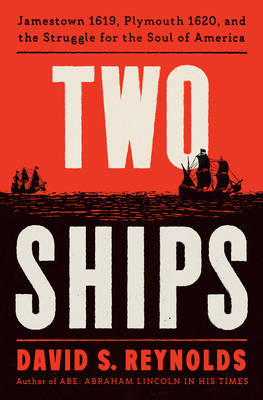
Two Ships
Jamestown 1619, Plymouth 1620, and the Struggle for the Soul of America
David S Reynolds
Livre relié | Anglais
51,45 €
+ 102 points
Format
Description
"Provocative . . . essential reading for today's polarized times." --Henry Louis Gates, Jr. "This is a brilliant conceit, wonderfully executed. . . . David S. Reynolds has found a new and compelling way to explore the infinite complexities of the American story--complexities that shape us still." --Jon Meacham A revelatory history of American division through the prism of two ships once widely used as symbols in the war of ideas between North and South--a struggle whose echoes remain with us today In the bitterly polarized decades leading up to the American Civil War, it was commonplace to argue that America's strife could be traced back to the arrival of two ships, less than a year apart--The White Lion, which brought the first enslaved Africans to Jamestown in 1619, and the Mayflower, which brought the Pilgrims to Plymouth Rock in 1620. In a deeper sense, David S. Reynolds shows us, in this magnificent book, those two ships, invoked by Frederick Douglass and many others, stood for two quite distinct realities: the Puritans and the Cavaliers, names and ideologies born in the bloodshed of the English Civil War. The Virginia colony, founded by royalists, was steeped in the ideas of divine right, which flowed down in rigid patriarchal hierarchies. Plymouth Colony's dissenters to the king and his church, while hardly perfect, carried the seeds of a more egalitarian political vision. These two ships of 1619 and 1620 played a key role in the battle of images and words that marked the roiling fight, and then war, over slavery. As Reynolds shows, there was a long stretch of time in America when everyone knew what Cavaliers and Puritans meant. It was North versus South, but more deeply, it was about whether social hierarchy was the natural order of things. But then, as America descended into the long night of Jim Crow, the metaphor of the two ships went to sleep as well. The meaning of the Mayflower and of Thanksgiving changed as they became mainstream, apolitical ideas. If the ships' status as cultural touchpoints before the Civil War tells us something vital about that conflict, their forgetting afterward tells us much about why the road to true equality has proved so stony. By dredging up these two ships' dueling images, the great David S. Reynolds enables us to make the same use of them that Frederick Douglass and his contemporaries did to challenge us, and to give us hope that we are up to the task.
Spécifications
Parties prenantes
- Auteur(s) :
- Editeur:
Contenu
- Nombre de pages :
- 480
- Langue:
- Anglais
Caractéristiques
- EAN:
- 9780593490235
- Date de parution :
- 09-06-26
- Format:
- Livre relié
- Format numérique:
- Genaaid
- Dimensions :
- 156 mm x 235 mm
- Poids :
- 657 g


Seulement chez Librairie Club
+ 102 points sur votre carte client de Librairie Club
Cadeau


Les avis
Nous publions uniquement les avis qui respectent les conditions requises. Consultez nos conditions pour les avis.